

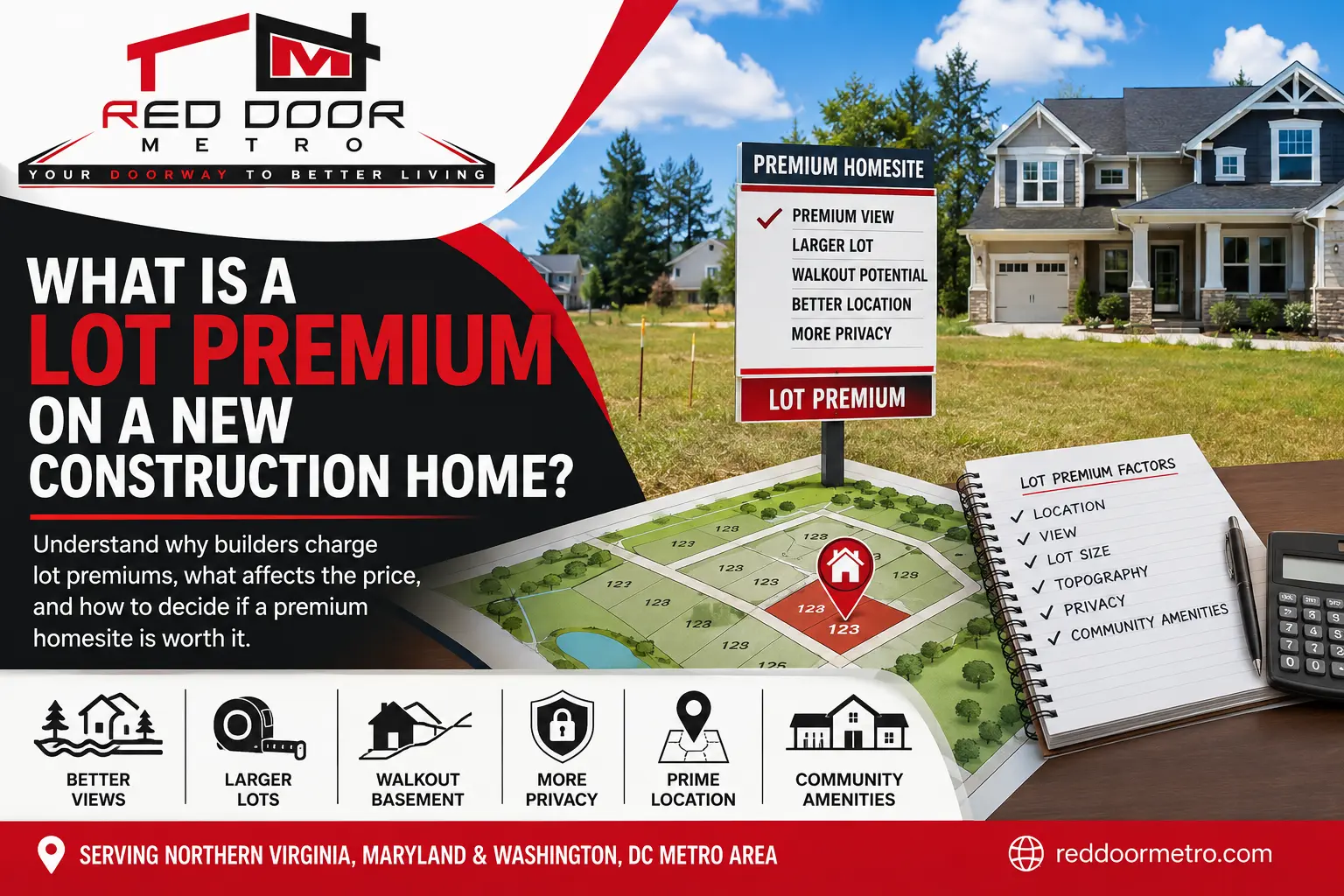
If you are shopping for a new construction home, you may see a home listed at one price and then discover that the builder wants an additional fee for the lot.
That extra cost is called a lot premium.
A lot premium is an additional amount a builder charges for a particular homesite because the lot has features that make it more desirable or more expensive to develop than a standard lot. A lot with a wooded view, larger backyard, walkout basement potential, better location within the community, or a premium view may cost more than a standard homesite.
For example, a builder might advertise a new home starting at $650,000, but the specific lot you want could have a $40,000 lot premium. Your effective starting price would then be $690,000 before other upgrades, options, taxes, closing costs, and other expenses.
A lot premium is not the same thing as a home upgrade. It is the extra price attached to the homesite itself.
If you are buying new construction, understanding lot premiums is important because the advertised base price may not represent the actual price of the home you want to build.
Quick Answer: What Is a Lot Premium?
A lot premium is an additional fee charged by a home builder for a particular homesite because that lot has desirable features or higher development value.
Lot premiums can vary widely depending on the community and location.
A builder may charge a premium for a lot because it has:
- A larger lot
- A wooded view
- A water view
- A golf-course view
- A walkout basement opportunity
- More privacy
- A better location within the neighborhood
- A corner location
- More usable backyard space
- Less neighboring development
- A desirable orientation
- Easier or more expensive site development
- A location near a community amenity
The lot premium is generally added to the base price of the home.
It may also affect the amount you need to finance.
Why Do Builders Charge Lot Premiums?
Not every homesite costs the builder the same amount.
Even when several lots are located in the same neighborhood, they can have very different characteristics.
One lot might be flat and easy to build on.
Another might sit on a slope and require additional site work.
One lot might back up to trees.
Another might face another row of houses.
A third lot might offer a wide-open view.
Builders use lot premiums to account for these differences in desirability, location, and sometimes development costs.
The builder is essentially saying:
“This homesite has features that make it more valuable than our standard lots, so it costs more.”
This is common in new construction communities.
What Is an Example of a Lot Premium?
Imagine a new construction community has homes starting at $600,000.
The builder offers several different lots.
| Homesite | Base Home Price | Lot Premium | Starting Price |
|---|---|---|---|
| Standard lot | $600,000 | $0 | $600,000 |
| Larger backyard | $600,000 | $15,000 | $615,000 |
| Wooded lot | $600,000 | $25,000 | $625,000 |
| Walkout lot | $600,000 | $35,000 | $635,000 |
| Premium view lot | $600,000 | $50,000 | $650,000 |
In this example, the home itself has not changed.
The difference comes from the homesite.
You may still choose additional options such as upgraded cabinets, flooring, countertops, appliances, or a finished basement. Those costs would be separate from the lot premium.
What Features Can Create a Lot Premium?
There is no universal list because each builder sets its own pricing.
However, several features commonly influence lot premiums.
1. Larger Lots
A larger homesite can be more valuable because it provides additional outdoor space.
For example, buyers may prefer a lot that offers:
- A larger backyard
- More space between neighboring homes
- Room for a deck or patio
- Space for landscaping
- More privacy
- Potential space for outdoor activities
A builder may charge more for these lots.
2. Wooded Lots
A lot backing to mature trees can be highly desirable.
Instead of looking directly at another home, the homeowner may have a natural view.
This can provide:
- More privacy
- A more attractive backyard
- A natural setting
- Less direct visibility from neighboring homes
Because these lots can be limited, builders may place a premium on them.
3. Water Views
Lots overlooking a lake, pond, river, or other water feature may command a higher price.
The value depends heavily on the location and the actual view.
A lot that technically backs toward a pond but has only a partial view may not provide the same value as a lot with an unobstructed view.
4. Walkout Basement Lots
A sloped lot can sometimes make it possible to build a walkout basement.
For buyers who want a basement with direct outdoor access, this can be a major advantage.
However, a walkout lot may also involve additional construction considerations.
Do not assume that paying a lot premium automatically means the finished basement is included.
The lot and the basement construction are separate issues.
5. Corner Lots
Corner lots can sometimes receive a premium because they may offer:
- More open space
- Greater visibility
- Additional yard area
- Fewer direct neighbors
- Different driveway placement
However, a corner lot is not automatically better for every buyer.
It may also mean more sidewalk, more street exposure, or less privacy.
6. Lots Near Amenities
Some buyers prefer homes close to:
- Pools
- Clubhouses
- Walking trails
- Parks
- Playgrounds
- Community entrances
A builder may charge more for particularly desirable locations.
But there can be a trade-off.
Being close to a community pool may be convenient, but it could also mean more traffic and noise.
Is a Lot Premium the Same as a Home Upgrade?
No.
This is one of the most important things to understand.
A lot premium applies to the homesite.
A home upgrade changes the house or its features.
For example:
Lot premium:
- $30,000 for a wooded lot
Home upgrades:
- $10,000 upgraded kitchen
- $8,000 flooring package
- $15,000 finished basement
- $5,000 upgraded bathroom
In this example, the buyer could have $30,000 in lot premiums plus $38,000 in home upgrades.
That means the advertised base price can increase quickly.
Does a Lot Premium Increase the Total Cost of the Home?
Usually, yes.
The lot premium is generally added to the base price of the home.
For example:
Base home: $650,000
Lot premium: $35,000
Upgrades: $45,000
Estimated purchase price before other costs: $730,000
This is why buyers should not compare new construction communities based only on the advertised starting price.
One builder may advertise a home at $650,000 with standard lots.
Another may advertise a similar home at $675,000 but include a better homesite or more features.
The real comparison is the final price for the home and lot you actually want.
Can You Negotiate a Lot Premium?
Sometimes, but it depends on the builder and the market.
Builders may have different pricing policies.
In a strong market with limited inventory, the builder may have little reason to reduce a lot premium.
In a slower market, there may be more room for incentives or negotiations.
Instead of asking only:
“Can you remove the lot premium?”
A buyer may want to ask about the builder’s overall incentives.
For example:
- Closing-cost assistance
- Interest-rate incentives
- Design-center credits
- Upgrade credits
- Appliance packages
- Price reductions
- Lot-premium discounts
A builder may be unwilling to reduce the lot premium but offer another incentive that provides similar financial value.
How Can You Tell If a Lot Premium Is Worth It?
This is where buyers need to slow down.
A lot premium is not automatically a good deal or a bad deal.
Its value depends on what you are getting for the additional money.
Ask yourself:
Do I actually value the feature?
If you love having a wooded backyard, paying extra for that view may make sense.
If you do not care about the view, paying $30,000 for it may not be a good use of your budget.
Will I use the extra space?
A larger lot may be valuable if you want:
- A pool
- A patio
- A play area
- A garden
- More privacy
But if you rarely use the backyard, the premium may matter less to you.
How long do I plan to stay?
If you expect to live in the home for many years, you may place more value on the features you enjoy every day.
If you plan to sell relatively soon, you should think carefully about whether future buyers will value the same feature.
Does the lot create additional costs?
A premium lot can sometimes involve more than the upfront premium.
For example, a sloped lot could affect:
- Landscaping
- Retaining walls
- Drainage
- Basement construction
- Grading
- Exterior improvements
Ask the builder what additional costs may be associated with the lot.
Is a Lot Premium Included in the Mortgage?
A lot premium is generally part of the purchase price when it is included in the purchase contract.
That means it can affect the amount you need to finance.
For example, suppose your home has:
- Base price: $600,000
- Lot premium: $40,000
- Upgrades: $30,000
Your purchase price could be approximately $670,000 before applicable additional costs.
If you finance the purchase, your lender will evaluate the overall transaction and your loan eligibility.
Your exact down payment, loan amount, interest rate, taxes, insurance, and monthly payment depend on your specific situation.
Do not assume that a lot premium can be treated separately from the purchase price.
Ask your lender to explain exactly how it will be handled in your loan.
Can a Lot Premium Affect Property Taxes?
It can, because the final value and assessment of a property can take the homesite and improvements into account.
However, property tax rules and assessments vary by location.
For a new construction purchase, buyers should ask how the property will be assessed and what the expected tax situation may be.
Do not assume that the tax bill will be based only on the builder’s advertised base price.
Are Lot Premiums Refundable?
Usually, buyers should not assume that a lot premium is refundable.
The answer depends on the purchase agreement and builder’s terms.
This is one reason why buyers should understand the contract before making a decision.
If you are putting money down to reserve a particular homesite, ask:
- Is the deposit refundable?
- When does it become non-refundable?
- What happens if financing fails?
- What happens if construction is delayed?
- What happens if I change my mind?
- Can I switch to another lot?
- Is the lot premium refundable if the contract is terminated?
Get the answers in writing.
What Should You Ask the Builder Before Paying a Lot Premium?
Before committing to a premium homesite, ask the builder or sales representative these questions:
- Why does this lot have a premium?
- How much is the lot premium?
- Is the premium negotiable?
- Has the premium changed recently?
- What exactly makes this lot different?
- Is the premium already included in the purchase price?
- Are there additional site-development costs?
- Will the lot affect the basement design?
- Are there drainage or grading considerations?
- Are there restrictions on landscaping or fencing?
- What will the neighboring lots look like?
- Is the view protected, or could future construction change it?
- Are there HOA restrictions?
- What incentives are available instead of reducing the lot premium?
- What happens to the lot deposit if I cancel?
These questions can help you understand what you are actually paying for.
Be Careful With “Premium View” Lots
One of the biggest mistakes buyers can make is paying for a view without understanding whether the view is permanent.
Suppose a builder sells a lot with a “wooded view.”
Ask whether the trees are:
- On your property
- On protected land
- On another private property
- In a conservation area
- In an area that could potentially be developed
The same issue applies to water views and open-space views.
A view is only as valuable as the likelihood that it will remain.
Ask the builder what is planned around the property and review available community plans.
Can a Lot Premium Increase Resale Value?
It can, but there is no guarantee that you will recover the entire lot premium when you sell.
This is an important distinction.
You may pay $50,000 more for a lot today.
That does not necessarily mean the home will be worth exactly $50,000 more when you sell it.
Future buyers may value the lot differently.
Market conditions can also change.
The premium may be easier to justify when the feature is highly desirable, such as:
- A rare water view
- Significant privacy
- A much larger usable lot
- A desirable walkout configuration
- A particularly attractive location
But buyers should not purchase a premium lot solely because they assume it will produce a guaranteed return.
Lot Premium vs Upgrade: Which Should You Choose?
If your budget is limited, you may have to decide between paying for a better lot and paying for upgrades inside the home.
For example:
Option A
$30,000 lot premium
You get a wooded backyard but keep standard interior finishes.
Option B
$30,000 in interior upgrades
You get a standard lot but upgraded flooring, cabinets, countertops, lighting, and bathrooms.
There is no universal right answer.
Think about what you will notice and use every day.
Interior finishes can sometimes be changed later.
You generally cannot move the house to a different lot.
For some buyers, the location of the home is more important than the finishes inside it.
For others, the interior features matter more.
A Lot Premium Can Be More Than Just a Price
When evaluating a lot premium, do not look only at the dollar amount.
Look at the entire homesite.
Consider:
- Sun exposure
- Backyard usability
- Privacy
- Street traffic
- Noise
- Nearby homes
- Future construction
- Drainage
- Slope
- Landscaping
- Driveway location
- Community amenities
- HOA rules
- Potential resale appeal
A $20,000 premium for a lot that you love may be more valuable to you than a $5,000 premium for a feature you barely notice.
Frequently Asked Questions
What is a lot premium on a new construction home?
A lot premium is an additional amount a builder charges for a particular homesite because of its location, size, view, privacy, terrain, or other desirable features.
Why do some new construction lots cost more than others?
Builders may charge more for lots that are larger, more private, have better views, offer walkout basement potential, sit in desirable locations, or have other features that make them more valuable or expensive to develop.
Is a lot premium negotiable?
Sometimes. Negotiability depends on the builder, inventory, market conditions, and current incentives. Even when the builder will not reduce the premium, other incentives may be available.
Is a lot premium included in the home’s purchase price?
It is generally added to the base price and becomes part of the overall purchase price. Confirm the exact pricing structure with the builder and your lender.
Can I finance a lot premium?
A lot premium can generally be part of the purchase price that is financed, subject to your loan program, appraisal, lender requirements, down payment, and financial qualifications.
Is a lot premium tax deductible?
Do not assume that a lot premium creates a separate tax deduction. Tax treatment depends on your circumstances and applicable tax rules. Ask a qualified tax professional for advice about your specific purchase.
Is a lot premium worth paying?
It depends on the lot and your priorities. A premium may be worthwhile if you highly value the feature and expect to enjoy it for many years. Compare the cost with what you are actually receiving.
Can a lot premium increase my home’s resale value?
It can contribute to the home’s overall appeal and value, but there is no guarantee that you will recover the full premium when you sell.
Do all new construction homes have lot premiums?
No. Some communities have standard lots with no premium, while others have several tiers of lot pricing. The builder determines how homesites are priced.
Can a builder remove a lot premium?
The builder may or may not agree to remove or reduce it. It is worth asking, particularly if the community has available inventory or the builder is offering incentives.
Does a walkout lot always have a lot premium?
Not always. Many builders charge more for lots that can support a walkout basement, but pricing varies by community and builder.
Can the builder change a lot premium?
Builders can change pricing and incentives depending on their sales strategy and available inventory. Once you sign a contract, the contract terms become especially important.
Should I pay a lot premium for a wooded view?
It depends on how much you value privacy and the view. Before paying, find out whether the trees are protected and whether future development could change the view.
What is the difference between a lot premium and a home upgrade?
A lot premium is an additional charge for the homesite. A home upgrade is an additional charge for features or finishes in the house, such as cabinets, flooring, countertops, or appliances.
Final Takeaway
A lot premium is an extra amount you pay for a particular homesite because it offers something the builder considers more valuable than a standard lot.
The premium could be for a larger backyard, wooded setting, water view, privacy, corner location, walkout basement potential, or another desirable feature.
The most important thing is not simply asking, “How much is the lot premium?”
Ask:
“What am I getting for that money, and will it actually matter to me?”
Before buying, compare the premium with the home’s total price, upgrades, financing costs, potential site costs, community plans, and your long-term plans.
And remember: a premium lot is not automatically a better investment. It is better only if the features are valuable to you and make sense within your overall budget.
If you are buying new construction in Northern Virginia, Maryland, or the Washington, DC metro area, a local real estate professional can also help you compare different communities and homesites before you commit to a particular lot.
This article provides general real estate information and is not legal, tax, mortgage, or financial advice. Builder contracts, lot pricing, community restrictions, and financing terms vary. Buyers should review the builder’s documents and consult the appropriate qualified professionals before making a purchase.