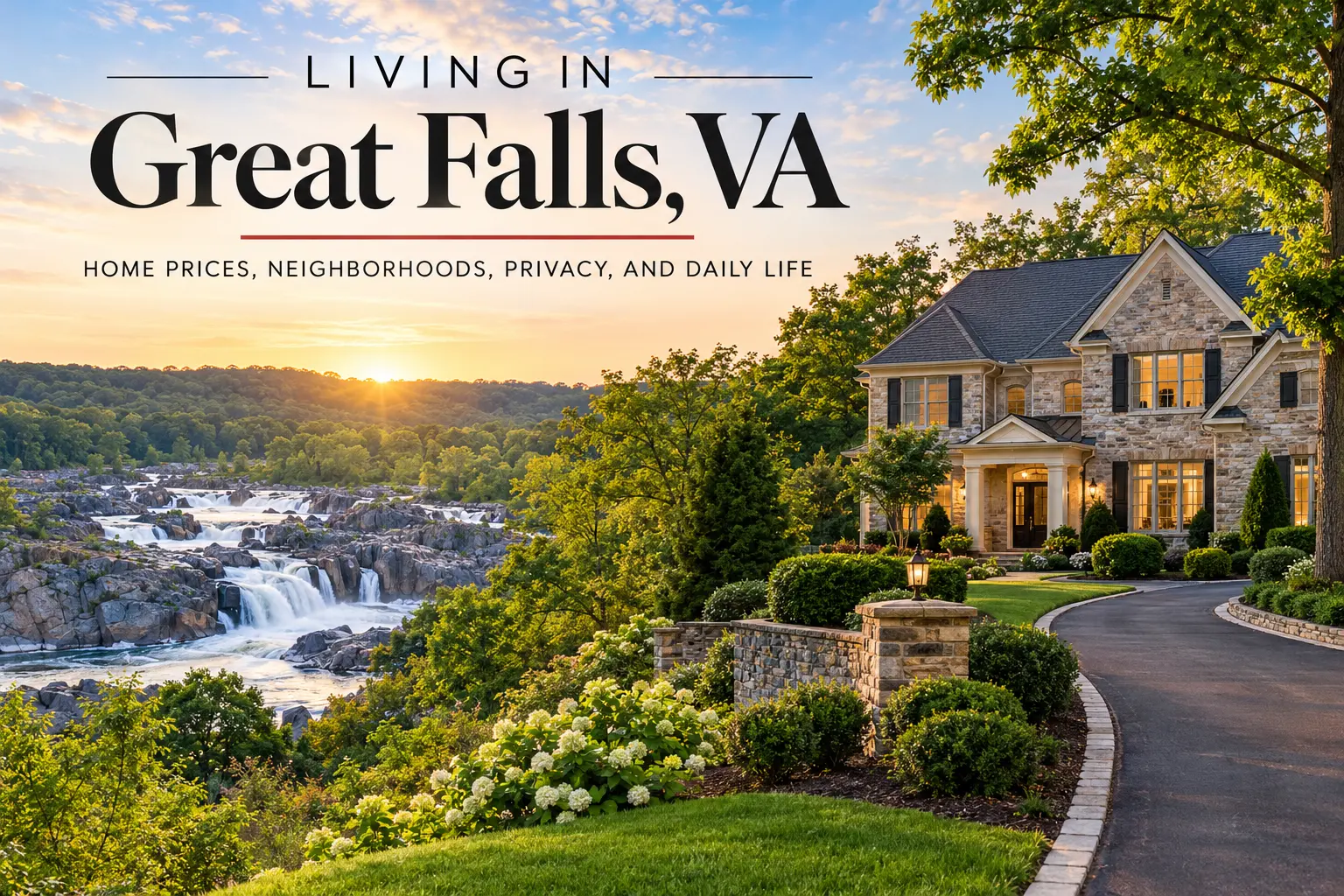
Living in Great Falls, Virginia, appeals to homebuyers who want more space, a quieter residential setting, and access to the employment centers and amenities of Northern Virginia and Washington, DC. Located in Fairfax County along the Potomac River, Great Falls is known for its large residential lots, wooded surroundings, custom homes, and access to outdoor recreation. It offers a different residential experience from denser communities such as Arlington, Reston, and parts of Tysons.
However, choosing Great Falls involves more than finding an attractive property. Buyers should consider the purchase price, lot maintenance, privacy, commuting routes, property utilities, neighborhood characteristics, and the amount of driving required for everyday errands. The right home depends on how you want to live, not simply on the size or appearance of the property.
Great Falls, VA at a glance
- Location: Fairfax County, Northern Virginia, near the Potomac River.
- Housing character: Primarily detached single-family homes, including established houses, renovated properties, and custom-built residences.
- Typical appeal: Larger lots, green surroundings, residential privacy, and access to regional employment centers.
- Outdoor recreation: Great Falls Park, Riverbend Park, trails, and other nearby outdoor destinations.
- Transportation: Primarily car-oriented, with access to major roads and nearby Metro connections.
- Budget considerations: Purchase price, property taxes, insurance, maintenance, landscaping, and potential well or septic costs.
What Is It Like to Live in Great Falls, VA?
Great Falls combines a low-density residential environment with access to the wider Washington metropolitan area. Instead of a landscape dominated by apartment towers and closely spaced homes, many parts of the community feature detached houses, mature trees, winding roads, and substantial yards.
The setting can appeal to buyers who value outdoor space, entertaining at home, gardening, or simply having more separation between neighboring properties. Depending on the lot and surrounding development, residents may enjoy wooded views, long driveways, outdoor living areas, or room for a pool and other amenities.
Great Falls also has a village-oriented commercial area with local businesses, restaurants, services, and community activities. Residents can visit the village center for selected everyday needs, while broader shopping, dining, and entertainment options are available in nearby communities, including McLean, Tysons, Reston, and Herndon.
The trade-off is that Great Falls does not offer the same concentration of walkable retail, apartment living, and public transportation found in some other parts of Northern Virginia. For many households, a car is an important part of daily life.
Great Falls, VA Home Prices: What Should Buyers Expect?
Great Falls is a high-cost residential market, particularly for buyers seeking large lots, substantial interior space, newer construction, or luxury finishes. Nevertheless, the community does not have one uniform price point. Property values can differ considerably based on lot size, location, age, condition, architectural quality, and the amount of renovation required.
Market reports should also be interpreted carefully. Listing prices describe what sellers are asking, while sold prices reflect completed transactions. Automated home-value estimates measure something different again. Reporting periods and the mix of homes sold can also affect the figures.
| Market indicator | Reported figure | How to interpret it |
|---|---|---|
| Median sold price | $1.525 million | Realtor.com’s September 2026 reported figure. |
| Median sale price | Approximately $1.9 million | Redfin’s figure for the three-month period ending September 2026. |
| Median listing price | Approximately $2.3 million | Realtor.com’s September 2026 asking-price indicator. |
These are historical market indicators, not a current appraisal or a promise of what a particular home will sell for. The providers use different measures and reporting windows. Buyers and sellers should check the latest available local sales data before making a pricing decision.
What Determines the Price of a Great Falls Home?
Several factors can influence the value of a property in Great Falls:
- Lot size and usability: A large parcel may offer more privacy and outdoor options, but the shape, slope, drainage, and usable area matter as much as total acreage.
- Home condition: A well-maintained house may require less immediate spending than an older property needing a major renovation.
- Construction and finishes: Custom architecture, quality materials, updated kitchens, and well-designed living spaces can influence buyer demand.
- Location within Great Falls: Road access, surroundings, proximity to amenities, and the character of nearby properties can affect desirability.
- Privacy and landscaping: Mature trees, setbacks, fencing where permitted, and the placement of neighboring homes may contribute to a property’s appeal.
- Infrastructure: Buyers should understand whether a home uses public water and sewer or private well and septic systems.
- Maintenance requirements: Older roofs, aging mechanical systems, extensive landscaping, and other property features can affect the total cost of ownership.
A buyer comparing two homes at similar asking prices should look beyond square footage. One property may offer a more functional floor plan and lower expected maintenance, while another may provide a larger lot but require substantial work. A careful comparison should account for both immediate costs and longer-term priorities.
Great Falls Neighborhoods and Residential Areas to Explore
Great Falls is not a single uniform subdivision. Its residential areas include established neighborhoods, wooded streets with detached homes, larger estate properties, and newer custom residences. Neighborhood names can help organize a home search, but buyers should also evaluate the individual street, lot, property condition, and surrounding land use.
1. Established Neighborhoods With Mature Trees
Established residential areas may appeal to buyers who appreciate mature landscaping, traditional architecture, and homes built before the latest wave of custom construction. Depending on the property, buyers may find classic Colonials, split-level designs, contemporary homes, and houses that have been expanded or renovated over time.
These properties can offer an opportunity to purchase a home with character and an established landscape. However, the age of a house makes due diligence especially important. Buyers should inspect the roof, windows, plumbing, electrical systems, HVAC equipment, drainage, and any visible signs of water intrusion.
It is also worth checking whether past additions or renovations were completed with the required permits. A property’s age and appearance do not necessarily reveal the condition of its underlying systems.
2. Areas With Larger Lots and More Separation
Some parts of Great Falls are especially attractive to buyers who prioritize distance from neighboring homes. Larger parcels can provide space for gardens, outdoor entertaining, recreational areas, and additional landscaping.
However, more land does not automatically guarantee complete privacy. A property’s outlook may be affected by neighboring development, road traffic, tree removal, changes in vegetation, or the position of the house on the lot. Buyers should examine the property in person and consider how it may look in different seasons.
When privacy is a major objective, review the lot boundaries, easements, applicable zoning, tree-related restrictions, and any nearby undeveloped parcels that could change in the future. Do not assume that wooded land visible from a backyard will remain undeveloped indefinitely.
3. Newer Custom Homes and Luxury Residences
Great Falls includes newer custom-built homes as well as older properties that have undergone substantial renovations. These residences may offer open layouts, larger kitchens, multiple living areas, home offices, finished lower levels, and extensive outdoor amenities.
For buyers considering a newer luxury home, the evaluation should extend beyond visual finishes. Ask about construction documentation, warranties, drainage, grading, energy performance, mechanical systems, and the maintenance requirements of specialty features such as pools or outdoor kitchens.
A visually impressive property can still have practical limitations. The most suitable home is one whose layout, location, infrastructure, and upkeep align with the household’s long-term needs.
4. Properties Near Outdoor Recreation
Some buyers focus their search on convenient access to parks, trails, and the Potomac River area. Great Falls Park and Riverbend Park are prominent outdoor destinations nearby, offering opportunities to experience the region’s natural landscape.
Proximity to recreation can be a lifestyle advantage, but it should not replace a full property assessment. Check actual driving routes, parking arrangements, trail access, road conditions, and any applicable environmental or land-use restrictions. A property described as being near a park may not have direct pedestrian access to it.
How to compare Great Falls neighborhoods
- Compare the actual lot size and usable outdoor area.
- Visit the property at different times of day to assess traffic and surrounding activity.
- Check driving distances to work, schools, shopping, and recreational destinations.
- Review property condition and likely near-term renovation costs.
- Confirm the relevant county jurisdiction, zoning, utilities, and any community restrictions.
- Compare recent sales of genuinely similar properties rather than relying on neighborhood averages alone.
Privacy in Great Falls: What Buyers Should Know
Privacy is one of the reasons buyers consider Great Falls. Larger setbacks, mature landscaping, and low-density residential development can create a more secluded environment than many high-density neighborhoods. The degree of privacy, however, depends on the specific property.
Lot Size Is Only Part of the Picture
A larger lot can create more separation between homes, but usable space matters. A property with substantial wooded acreage may have less level yard space than expected, while a smaller parcel with thoughtful landscaping may provide a more private outdoor setting.
Look at the location of neighboring houses, windows facing the yard, driveway placement, outdoor seating areas, and the height and density of existing vegetation. Visit during both leaf-on and leaf-off seasons when possible, because deciduous trees can provide considerably less screening in winter.
Understand Easements and Land-Use Rules
Before assuming that a lot can accommodate a new fence, guest house, pool, garage, or expansion, confirm the applicable rules. Setbacks, easements, drainage areas, zoning, environmental limitations, and permit requirements may restrict how land can be used.
Buyers interested in major future improvements should investigate these questions before removing contingencies or committing to a project. The fact that a neighboring property has a particular feature does not necessarily mean the same improvement will be permitted on another lot.
Consider Future Surroundings
Privacy can change when trees are removed, neighboring properties are renovated, or undeveloped land changes ownership. Buyers should review the immediate surroundings and investigate any known development proposals that could materially affect the property.
For a high-value home, this process should include an examination of survey information, property boundaries, drainage, easements, and any restrictions that affect landscaping or construction. Professional advice may be appropriate where boundaries or land-use rights are unclear.
The Real Cost of Owning a Home in Great Falls
The purchase price is only one part of the financial commitment. A large house on a substantial lot may require more ongoing maintenance than a smaller property, and certain homes have infrastructure or amenities that create additional expenses.
| Expense | What to investigate |
|---|---|
| Property taxes | Confirm the applicable county, current assessed value, tax rate, and any applicable charges. |
| Home insurance | Obtain a property-specific quote that reflects replacement cost and relevant coverage needs. |
| Maintenance and repairs | Evaluate the roof, exterior, HVAC, plumbing, electrical systems, and age of major equipment. |
| Landscaping | Estimate the cost of lawn care, tree maintenance, seasonal cleanup, irrigation, and drainage work. |
| Well and septic systems | Confirm the property’s water and wastewater arrangements and obtain appropriate inspections and tests. |
| Pools and outdoor amenities | Budget for servicing, equipment, seasonal preparation, repairs, and safety requirements. |
| Utilities and energy | Review available utility history and assess the efficiency of the home’s heating and cooling systems. |
| Community or association costs | Check whether the property is subject to an HOA or other recorded obligations; do not assume fees are universal. |
Private well and septic systems deserve particular attention. Depending on the property, buyers may need water-quality testing, a well inspection, a septic evaluation, and a review of system age and maintenance history. The relevant requirements and recommendations should be confirmed for the individual home.
Buyers should also distinguish between a property’s assessed value for taxation and its likely market value. These figures serve different purposes and may not be the same.
Daily Life in Great Falls: Shopping, Dining, and Local Activities
Everyday life in Great Falls tends to revolve around residential routines, local services, outdoor recreation, and trips to nearby commercial centers. The experience can suit households that prefer a quieter home environment while remaining within driving distance of a broader range of amenities.
Great Falls Village Centre
The village center and surrounding commercial areas provide a local destination for selected dining, shopping, services, and community activities. This gives residents a place to visit without necessarily traveling to a major shopping district for every errand.
However, the range of businesses and opening hours can change. Buyers should explore the actual stores and services they expect to use rather than assuming every daily need can be met within walking distance.
Restaurants and Shopping Nearby
Great Falls residents can also access dining and shopping options in nearby McLean, Tysons, Reston, and Herndon. These areas expand the choice of restaurants, retail stores, entertainment, and professional services available within the wider region.
The practical convenience of these destinations depends on the home’s exact location and traffic conditions. Before purchasing, map the routes to your most frequent destinations and test them at the times you would normally travel.
Parks, Trails, and Outdoor Recreation
Outdoor access is a significant part of Great Falls’ appeal. Nearby recreational destinations include Great Falls Park and Riverbend Park, where visitors can experience trails, river scenery, and natural landscapes.
Buyers who enjoy hiking, walking, photography, or spending time outdoors may find this setting especially attractive. Still, it is worth checking which trails and facilities are convenient from the specific home and whether access requires driving.
Community Activities
Local events and seasonal activities can provide opportunities to connect with the community. Markets, outdoor gatherings, and events around the village area contribute to the local lifestyle, although schedules and programming vary throughout the year.
For buyers relocating from another region, visiting on an ordinary weekday as well as a weekend can help reveal the area’s everyday rhythm beyond its most prominent attractions.
Commuting From Great Falls to Tysons, Reston, and Washington, DC
Great Falls offers access to several major employment centers in Northern Virginia and the Washington metropolitan area. However, commute times depend on the property’s location, destination, departure time, route, and traffic conditions.
| Destination | What to consider |
|---|---|
| Tysons | Access to offices, retail, restaurants, and nearby Silver Line Metro stations. |
| Reston and Herndon | Useful for people working in the Dulles technology and business corridor; test the actual route and peak traffic. |
| Washington, DC | The drive can vary substantially with traffic, route choice, and time of day. |
| Dulles International Airport | Consider the exact airport route, traffic conditions, and how often you travel. |
Great Falls itself does not have a Metrorail station in the center of the community. Some residents drive to a nearby station when rail service is useful. Others commute by car or combine driving with other transportation options.
Before making an offer, conduct a realistic commute test if possible. A route that looks short on a map can become time-consuming during peak periods. For households with multiple workers, evaluate each person’s journey separately rather than focusing on a single destination.
Schools and Family Considerations
For households with children, school assignments may be an important part of the home search. Much of Great Falls is associated with Fairfax County Public Schools, but school assignments must be checked for the exact property. A mailing address alone should not be treated as a guarantee of school eligibility or attendance.
Buyers should verify the current school boundary information directly with the relevant school district and consider transportation, after-school activities, and the daily logistics of getting children to school.
Families should also consider how the property’s layout supports their routines. Home offices, flexible living spaces, storage, outdoor areas, and proximity to activities may matter as much as bedroom count.
School information and boundary assignments can change. Verify current details during the homebuying process rather than relying exclusively on listing descriptions or neighborhood assumptions.
Great Falls vs. McLean: Which Community Is the Better Fit?
Great Falls and McLean are both established Northern Virginia destinations for buyers considering higher-value homes. Their residential character and property options can differ, so the choice should be based on lifestyle, location, and the specific homes available.
| Factor | Great Falls | McLean |
|---|---|---|
| Residential character | Often associated with wooded settings, larger lots, and detached homes. | Offers varied residential settings, from estate properties to homes in more connected neighborhoods. |
| Privacy | Many properties appeal to buyers seeking greater separation and outdoor space. | Privacy varies widely by neighborhood, street, and lot. |
| Daily convenience | Many errands require a drive to local businesses or nearby centers. | Convenience varies, with some areas closer to shopping, offices, and transportation. |
| Home search priorities | Often suits buyers prioritizing land, a detached home, and a quieter setting. | May suit buyers prioritizing a particular commute, neighborhood setting, or mix of home options. |
Neither community is automatically better for every buyer. A home in McLean may offer a more convenient commute for one household, while a property in Great Falls may better support another household’s need for outdoor space and separation from neighbors.
Compare individual homes using the same criteria: total ownership cost, lot usability, condition, commute, future resale considerations, and the features that matter most to your household.
For more local guidance, explore Red Door Metro’s Fairfax County community information and use the advanced home search to refine your options.
Who Should Consider Buying a Home in Great Falls?
Great Falls may be worth exploring if your priorities align with its residential character and ownership requirements.
- Buyers seeking more outdoor space: You want a substantial yard or a property with room for outdoor activities.
- Households prioritizing privacy: You prefer more separation between homes and are prepared to evaluate the actual screening and layout of each lot.
- Luxury-home buyers: You are considering custom construction, extensive interior space, or higher-end property features.
- Outdoor enthusiasts: You want convenient access to parks, trails, and river scenery.
- Professionals working in Northern Virginia: Your employment location makes Great Falls practical after you have tested the commute.
- Buyers comfortable with property upkeep: You understand the potential responsibilities of maintaining a larger home, landscaped grounds, and specialized systems.
Great Falls may be less suitable for buyers who prioritize a highly walkable environment, rely on immediate access to public transportation, want a low-maintenance condominium, or need a broad range of lower-priced housing options within the community.
The most effective decision is based on the way you expect to use the home and the full cost of owning it, rather than on prestige or appearance alone.
A Practical Checklist for Buying a Home in Great Falls
Before committing to a property, use this checklist to structure your evaluation.
Property and financial due diligence
- Review comparable recent sales and establish a realistic budget.
- Estimate mortgage payments, property taxes, insurance, and closing costs.
- Inspect the home and identify major repairs or upcoming replacements.
- Evaluate the lot’s usable area, grading, drainage, and landscaping needs.
- Confirm water and wastewater arrangements, including well and septic details where applicable.
- Review survey information, easements, zoning, permits, and any relevant restrictions.
- Investigate HOA or other recorded obligations, if applicable.
- Check current school assignments if they are relevant to your household.
- Test commute routes and measure practical access to daily services.
- Consider how neighboring land and future development could affect privacy.
A thorough review helps buyers understand what they are purchasing and reduces the risk of making a decision based solely on a property’s appearance or listing description.
Meet George M. Mrad, Founder and CEO of Red Door Metro

George M. Mrad is the Founder and CEO of Red Door Metro, a real estate organization serving clients across the Washington metropolitan region. The firm focuses on helping buyers and sellers navigate real estate decisions with attention to property selection, market context, and individual client objectives.
For a buyer considering Great Falls, the process should involve more than identifying a home that looks appealing online. Comparing properties, understanding ownership costs, evaluating location, and identifying questions that require further investigation can help create a more informed purchase decision.
Learn more about the people behind the company on the Red Door Metro team page.
How Red Door Metro Helps Buyers Explore Great Falls Real Estate
Red Door Metro works with buyers and sellers navigating residential real estate across the Washington metropolitan region. For someone considering Great Falls, a structured search can help narrow the options according to location, property type, budget, and the features that matter most.
A useful home search begins by identifying practical priorities. Buyers may want a particular lot size, a dedicated home office, an updated kitchen, a pool, a specific commute, or a property that requires less renovation. Establishing these criteria early makes it easier to compare available homes consistently.
Buyers can use the Red Door Metro advanced search to explore available listings and refine their search. The firm’s About Us page provides more information about the company, while the Meet the Team page introduces its real estate professionals.
For buyers evaluating Great Falls, the objective is to identify a property that fits their lifestyle and financial plan—not simply the largest home within a target price range. A careful comparison of property condition, privacy, commute, and long-term upkeep can make the decision more useful and sustainable.
Explore Great Falls Real Estate With a Clear Plan
Compare available homes, identify your priorities, and explore residential opportunities across Northern Virginia with Red Door Metro.
Search Homes
Contact Red Door Metro
Red Door Metro · 1775 Tysons Boulevard, Suite 1450, McLean, VA 22102 · 703-564-4000
Frequently Asked Questions About Living in Great Falls, VA
Is Great Falls, VA, an expensive place to live?
Great Falls is generally considered a high-cost housing market in Northern Virginia. Home prices vary significantly by lot size, construction, condition, and location. Buyers should also budget for property taxes, insurance, maintenance, landscaping, and any private well or septic expenses associated with a particular property.
What is the typical home price in Great Falls, VA?
There is no single price that accurately represents every Great Falls home. September 2026 market reports showed different results depending on the provider and metric, including a median sold price of $1.525 million from Realtor.com and a median sale price of approximately $1.9 million from Redfin for the three-month period ending in September. Buyers should review recent comparable sales before estimating a property’s value.
Is Great Falls, VA, a good place to live?
Great Falls may be a good fit for people who value detached homes, outdoor space, a relatively low-density residential environment, and access to Northern Virginia employment centers. Whether it is the right choice depends on the buyer’s budget, commute, preferred lifestyle, and willingness to maintain the property.
Are homes in Great Falls private?
Many properties offer larger lots and greater separation from neighboring homes than buyers might find in denser communities. However, privacy varies by parcel. Buyers should inspect the actual lot, neighboring properties, vegetation, setbacks, and potential future development rather than relying on lot size alone.
Does Great Falls have condos or townhouses?
Great Falls is predominantly known for detached single-family homes, and its housing choices are more limited than those of nearby communities with extensive condominium and townhouse development. Buyers seeking lower-maintenance or attached housing may want to compare additional areas in Northern Virginia.
Is Great Falls, VA, walkable?
Walkability depends on the exact address. The village center offers selected local businesses and services, but much of Great Falls is spread out and car-oriented. Buyers should check pedestrian routes and the actual distance to the destinations they expect to visit regularly.
How do residents commute from Great Falls to Washington, DC?
Residents commonly drive or combine driving with other transportation options. Great Falls does not have a Metrorail station in its center, but nearby stations can provide access to the regional rail network. Commute times depend on the starting address, destination, route, and traffic.
Do Great Falls homes use well and septic systems?
Some properties use private wells, septic systems, or both. Buyers should verify the infrastructure at the specific address and arrange appropriate inspections and testing. Do not assume that all homes in Great Falls have the same water and wastewater arrangements.
What should I inspect before buying a home in Great Falls?
In addition to a general home inspection, buyers should consider the property’s drainage, roof, major mechanical systems, lot boundaries, easements, and any pool or other specialty amenities. Where applicable, arrange well-water testing and a septic evaluation. A qualified professional can help identify issues that need additional investigation.
How can I find homes for sale in Great Falls, VA?
Start by defining your budget, preferred lot size, home condition, commute requirements, and must-have features. You can use the Red Door Metro advanced home search to explore listings and refine your options.
Final Thoughts on Living in Great Falls, VA
Great Falls offers a distinctive residential option for buyers who want a detached home, outdoor space, and access to the broader Northern Virginia region. Its larger-lot properties and wooded surroundings can appeal to people seeking more privacy, while nearby communities provide additional shopping, dining, employment, and transportation options.
The decision requires a practical assessment of both benefits and trade-offs. Home prices can be substantial, many errands require driving, and larger properties may involve significant maintenance. Lot characteristics, home condition, utilities, commute routes, and future land-use considerations deserve careful attention before making an offer.
For buyers who value space and a quieter residential setting, Great Falls is worth exploring alongside other Northern Virginia communities. Compare individual properties, review current market data, and focus on the home that best matches your needs, budget, and long-term plans.
To continue your search, visit Red Door Metro, explore available listings, or contact the team to discuss your real estate goals.