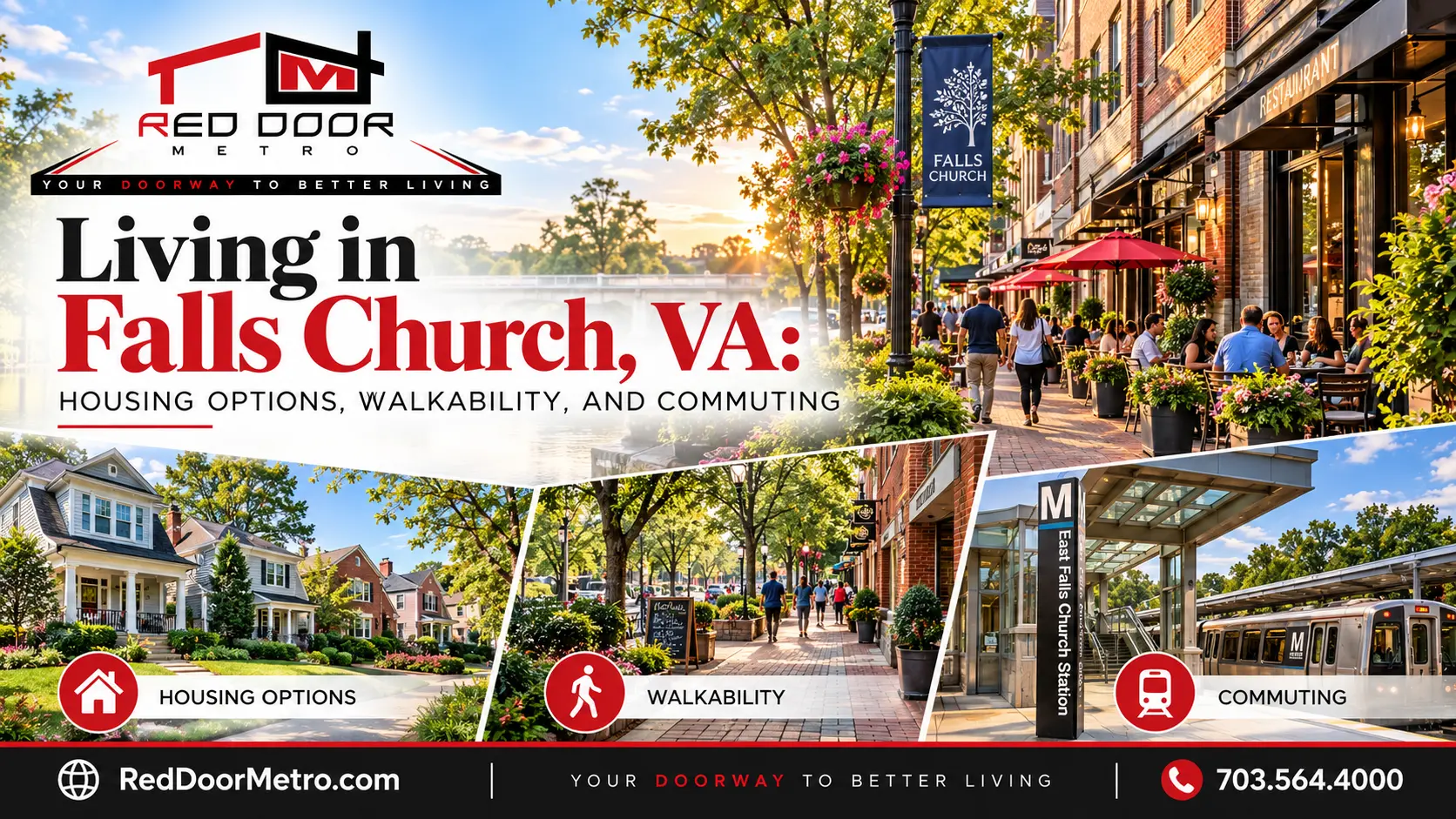
Living in Falls Church, Virginia, offers a combination of established residential neighborhoods, convenient transportation, local shops and restaurants, and access to Washington, D.C., and the wider Northern Virginia region. Buyers can explore detached homes, townhouses, condominiums, and newer residential developments, depending on their budget and preferred lifestyle. Some areas offer a walkable neighborhood experience, while others are better suited to people who drive regularly.
One important detail can affect your home search: the independent City of Falls Church is different from the surrounding Fairfax County communities that use a Falls Church mailing address. Understanding that distinction can help you compare housing, property taxes, schools, transportation, and local services before choosing a home.
Living in Falls Church: Quick Overview
- Location: Northern Virginia, near Arlington, McLean, Tysons, and Washington, D.C.
- Housing options: Detached houses, townhouses, condominiums, apartments, and newer mixed-use developments.
- Walkability: More convenient in central Falls Church and certain mixed-use areas; more car-dependent in many surrounding residential neighborhoods.
- Public transportation: Access to nearby East Falls Church and West Falls Church Metro stations, along with regional bus services.
- Outdoor recreation: The Washington & Old Dominion Trail, neighborhood parks, and nearby recreational facilities.
- Important distinction: A Falls Church postal address does not automatically mean a property is within the independent City of Falls Church.
If you are considering a move, this guide explains the housing choices, neighborhood differences, walkability, commuting options, everyday expenses, and practical questions to consider before buying a home in Falls Church.
Where Is Falls Church, Virginia?
Falls Church is located in Northern Virginia, within the Washington metropolitan area. Its location provides access to employment centers and destinations throughout Arlington, Fairfax County, Tysons, and Washington, D.C.
The independent City of Falls Church is a compact jurisdiction commonly known as “The Little City.” Its commercial areas, residential streets, parks, and community facilities create a different environment from the larger suburban areas surrounding it.
The wider Falls Church area also includes neighborhoods in Fairfax County. These communities may have Falls Church mailing addresses even though they are outside the independent city. The distinction matters because local government, property taxes, school assignments, and some public services depend on the property’s actual jurisdiction.
Before comparing homes, confirm the property’s municipal or county location rather than relying on the city name shown in the mailing address or real estate listing.
What Is It Like to Live in Falls Church, VA?
The Falls Church area offers several different residential experiences. In central Falls Church, residents can find restaurants, local businesses, community events, and pedestrian-friendly streets. Other neighborhoods have a more traditional suburban layout, with detached homes, driveways, yards, and greater reliance on driving.
This variety is one of the area’s defining characteristics. You can search for a home near local shops and public transportation or prioritize a larger house, outdoor space, and a quieter residential street. The right choice depends on how you want to spend your time and what you need from your home.
Daily life can include commuting to offices in Northern Virginia or Washington, shopping at neighborhood businesses, visiting parks, using the regional trail network, and attending community activities. The specific experience depends heavily on the property’s location.
A Small-City Center With Suburban Options
Central Falls Church has a recognizable commercial core, with shops, restaurants, and community destinations around Broad Street and Washington Street. Residents may be able to complete some errands on foot, depending on where they live.
Outside the central area, the housing pattern becomes more varied. Some neighborhoods have sidewalks and nearby amenities, while others require a car for grocery shopping, appointments, or commuting. When choosing a home, evaluate the immediate surroundings instead of assuming that all Falls Church addresses offer the same level of convenience.
Housing Options in Falls Church
Housing in Falls Church ranges from older detached homes on established streets to modern townhouses and condominiums. Buyers should compare not only the purchase price but also the amount of space, maintenance responsibilities, transportation access, and ongoing costs associated with each property type.
1. Single-Family Homes
Detached homes are an important part of the housing landscape across the wider Falls Church area. Depending on the neighborhood, buyers may find older ramblers, traditional houses, renovated properties, and newly constructed homes replacing older buildings.
A detached house may provide a private yard, driveway, additional storage, and more control over the property. These features can appeal to buyers who want outdoor space, room for hobbies, or flexibility to adapt the home over time.
However, a larger property can also mean additional maintenance. Before buying, inspect the roof, windows, plumbing, electrical systems, heating and cooling equipment, drainage, and foundation. For older homes, consider the potential cost of modernization and verify that major renovations were completed with any required permits.
Buyers considering an older home for renovation or replacement should also check zoning requirements, setbacks, lot coverage, tree protections, easements, and other applicable restrictions before assuming a particular project is possible.
2. Townhouses
Townhouses offer a middle ground between a detached house and a condominium. They may provide multiple floors, separate living and sleeping areas, a garage or assigned parking, and a small private outdoor space.
For buyers who want more interior space without maintaining a large yard, a townhouse may be a practical choice. Some developments are located near shopping, major roads, or public transportation, although the actual convenience varies by community.
Check whether the property belongs to a homeowners association, what the fees cover, and whether there are restrictions on exterior changes, parking, pets, or rentals. Review the association’s financial documents and any planned assessments before making a final decision.
3. Condominiums
Condominiums can be an option for first-time buyers, people looking to downsize, commuters, and anyone who prefers a smaller private living space. Depending on the building, residents may have access to shared amenities and may not be responsible for maintaining the building exterior individually.
Condominium living can reduce some maintenance responsibilities, but it does not eliminate ownership costs. Monthly association fees, insurance, utilities, parking, and special assessments can substantially affect the total cost of ownership.
Review the condominium association’s budget, reserve funds, insurance arrangements, meeting records, building maintenance plans, and rules. A relatively low purchase price may be less attractive if the building needs major repairs or has insufficient reserves.
4. Newer Homes and Mixed-Use Developments
Newer residential developments provide another option for buyers who prefer contemporary layouts, updated systems, and access to shared amenities. In mixed-use communities, homes may be close to restaurants, shops, grocery stores, and other everyday destinations.
For some buyers, this arrangement can reduce the need to drive for every errand. It is still important to check the actual walking route, road crossings, sidewalk connections, and distance to the destinations you expect to visit regularly.
When purchasing new construction, review the builder’s contract, included finishes, warranty coverage, construction timeline, and procedures for documenting incomplete work. Confirm the costs of any upgrades that are not included in the advertised base price.
| Property type | Potential advantages | What to check |
|---|---|---|
| Detached house | Private yard, more independence, and flexible living space. | Repairs, lot condition, maintenance, and renovation restrictions. |
| Townhouse | Multiple levels and a balance of space and maintenance. | Association fees, parking, shared walls, and community rules. |
| Condominium | Smaller footprint and potentially less exterior maintenance. | Building condition, monthly fees, reserves, and special assessments. |
| New construction | Modern layouts and newer building systems. | Builder reputation, contract terms, upgrades, and warranties. |
Walkability in Falls Church, VA
Walkability is one of the area’s most useful lifestyle considerations, but it varies by neighborhood. Some parts of Falls Church have sidewalks, nearby businesses, parks, and community destinations that make walking practical. In other areas, distances between destinations, busy roads, or gaps in pedestrian infrastructure can make driving more convenient.
Central Falls Church is worth exploring if you want to walk to restaurants, shops, or community events. Areas around newer mixed-use developments may also provide access to everyday services without requiring a car for every trip.
However, a listing that describes a home as walkable does not necessarily mean that every daily need is within an easy walk. A property may be close to a restaurant but farther from a grocery store, Metro station, or medical office. The safest and most useful approach is to test the actual route from the property.
What to Check When Evaluating a Walkable Neighborhood
- Sidewalk coverage: Check whether sidewalks connect the home to nearby destinations without requiring you to walk along an uncomfortable or unsafe road shoulder.
- Road crossings: Look at intersections, traffic speeds, crossing signals, and pedestrian visibility.
- Everyday errands: Measure the route to grocery stores, pharmacies, restaurants, and other places you use frequently.
- Transit access: Check the walking route to bus stops or Metro stations, including hills, crossings, and station entrances.
- Evening conditions: Consider lighting, traffic, and how comfortable the route feels after dark.
- Weather and accessibility: Think about rain, summer heat, winter conditions, mobility needs, and whether the route remains practical year-round.
If walking is a major reason for your move, visit the neighborhood on foot before making an offer. Walk from the property to the places you would realistically use, rather than relying only on a map or a general neighborhood description.
The W&OD Trail and Outdoor Recreation
The Washington & Old Dominion Regional Trail is a notable outdoor amenity in the Falls Church area. The paved regional trail provides a route for walking, running, cycling, and other permitted nonmotorized activities.
For people who enjoy being outdoors, trail access can be a useful factor when comparing homes. A nearby trail may offer a convenient way to exercise, take a recreational ride, or reach certain destinations without using a car.
The value of trail access depends on the actual entrance and route from the property. Check how you would reach the trail, whether the approach involves busy intersections, and whether the location suits the activities you plan to do.
In addition to the regional trail, residents can explore local parks, playgrounds, recreation facilities, and green spaces throughout the surrounding area. Review the parks near any property you are considering and check the facilities, operating hours, and programs that matter to your household.
Commuting From Falls Church to Washington, D.C.
Falls Church is positioned for access to Washington, D.C., and employment centers throughout Northern Virginia. Residents can commute by car, Metro, bus, bicycle, or a combination of transportation methods, depending on their location and destination.
Driving routes in the area include Interstate 66 and major roads such as Route 7, Route 29, and Route 50. These connections can be useful for reaching Washington, Arlington, Tysons, and other parts of the region. Traffic congestion, road conditions, and peak-hour demand can significantly affect travel times.
Public transportation offers an alternative for some commuters. The nearby East Falls Church and West Falls Church Metro stations connect riders to parts of the Washington metropolitan area. The exact station and route that work best depend on where you live and where you need to go.
Before purchasing a home, test your commute during the hours you normally travel. A route that looks short on a map may take longer during peak periods, and the closest Metro station may not provide the most convenient route to your workplace.
Commuting by Metro
Metro can be a practical option for residents traveling toward Washington, D.C., Arlington, and other locations served by the rail network. East Falls Church is served by the Orange and Silver lines, while West Falls Church is served by the Orange Line.
The most convenient station depends on your address, access route, and destination. Also consider the time needed to walk or drive to the station, find parking if available, and complete the final part of the journey after leaving the train.
If you expect to use Metro frequently, check current schedules, service notices, fares, station facilities, and available parking directly with the transit operator before finalizing your transportation plan.
Commuting by Bus
Local and regional bus services connect parts of Falls Church with nearby communities and transit stations. Depending on your location, a bus may provide a useful connection to Metro or a direct route toward a work or shopping destination.
Check the actual stop location, service frequency, operating hours, transfer requirements, and walking route. A nearby bus stop is most useful when the schedule and route match your daily routine.
Commuting by Car
Driving remains important for many households in the Falls Church area, especially in neighborhoods farther from Metro stations or commercial centers. A car can make grocery shopping, school drop-offs, appointments, and regional travel more convenient.
However, owning a car adds expenses such as fuel, insurance, maintenance, parking, and possible tolls. Buyers should also consider how many vehicles the household needs and whether the property provides enough driveway, garage, or permitted street parking.
For a realistic commute assessment, test the drive to work during a normal weekday morning and evening. If your schedule changes frequently, consider alternative routes and the availability of public transportation in case driving becomes inconvenient.
Commuting Comparison
| Transportation option | May work well for | Main consideration |
|---|---|---|
| Metro | Commuters traveling along rail corridors. | Station access, transfers, schedule, and last-mile travel. |
| Bus | Travelers with a useful nearby route or connection. | Route frequency, stop location, and transfer times. |
| Car | Households traveling to multiple locations or suburban destinations. | Traffic, parking, fuel, insurance, and maintenance. |
| Walking or cycling | Short local trips and suitable routes to nearby destinations. | Sidewalks, crossings, cycling infrastructure, distance, and weather. |
Understanding Falls Church Neighborhoods
Choosing a neighborhood is about more than finding a home with the right number of bedrooms. Buyers should consider the surrounding streets, access to shops and transportation, property types, traffic, and the local government’s jurisdiction.
The following areas provide useful starting points for a home search. Their boundaries and housing characteristics vary, so confirm the exact location of each property.
Central Falls Church
Central Falls Church may appeal to buyers who want access to local shops, restaurants, community events, and pedestrian-friendly streets. The commercial areas around Broad Street and Washington Street provide destinations that can make some everyday activities easier to complete on foot.
Housing options vary by street and include older residential properties and newer residential developments. Buyers should compare the location’s walkability with its traffic patterns, parking, home condition, and price.
West Falls and the Metro Area
The West Falls area includes newer and evolving mixed-use development near the West Falls Church Metro station. Depending on the particular property and the development’s current offerings, buyers may find residential options near retail, services, and transportation connections.
This type of setting may suit people who value convenient access to amenities. Before buying, check which businesses are currently open, what is still under development, and how the property connects to the Metro station and surrounding roads.
Pimmit Hills and Idylwood
Pimmit Hills and Idylwood are communities in the broader Falls Church area of Fairfax County. Housing options include older detached homes, renovated properties, and condominium communities. Their locations can be useful for buyers comparing access to Tysons, major roads, and nearby transit.
Buyers interested in older houses should examine property condition, lot characteristics, and any restrictions affecting future renovations. The convenience of a particular address will depend on its distance from Metro, shopping, and the routes you use most often.
Lake Barcroft and Bailey’s Crossroads
Lake Barcroft and Bailey’s Crossroads offer additional choices within the wider Falls Church mailing-address area. Lake Barcroft is known for its residential setting around a private lake, while Bailey’s Crossroads includes a mix of residential properties, shopping areas, and condominium buildings.
Access to the lake and associated amenities in Lake Barcroft is subject to community rules and eligibility requirements. Buyers should confirm any membership, association, or watershed-related obligations that apply to a specific property.
In Bailey’s Crossroads, evaluate road access, parking, nearby services, and public transportation routes. These details can influence how convenient a property feels in everyday use.
Seven Corners and Surrounding Neighborhoods
Seven Corners is a major road junction and commercial area within the broader Falls Church region. Nearby residential neighborhoods offer a range of housing options, but driving conditions and pedestrian access can vary considerably around major roads and intersections.
If you are considering a home near Seven Corners, test the routes you expect to use and inspect the pedestrian connections to nearby shops or transit. A property can be close to a destination in straight-line distance while still requiring a longer route on foot.
Compare Nearby Communities
If you are still deciding where to live in Northern Virginia, explore Red Door Metro’s Fairfax County community guide and use the advanced home search to compare available properties.
Housing Costs and the True Cost of Living
The cost of living in Falls Church depends on the type of home you choose, the property’s jurisdiction, your transportation habits, and your household’s everyday expenses. There is no single housing price that accurately describes the entire Falls Church area because the independent city and the surrounding Fairfax County communities contain different types of properties.
When evaluating homes, compare recently closed sales for similar properties rather than relying on a broad regional average. A renovated detached home, a smaller condominium, and a newly built townhouse may appeal to different buyers and have different ongoing costs.
Costs to Include in Your Budget
- Mortgage payment: Consider the down payment, interest rate, loan term, and monthly principal and interest.
- Real estate taxes: Confirm whether the property is in the independent city or Fairfax County and verify the applicable tax rate and assessment.
- Homeowners insurance: Obtain a quote based on the property, coverage requirements, and replacement cost.
- Utilities: Account for electricity, gas, water, internet, and other services.
- Maintenance and repairs: Set aside money for the roof, mechanical systems, appliances, landscaping, and unexpected repairs.
- Association fees: If applicable, review monthly or annual fees and any planned special assessments.
- Transportation: Include car payments, fuel, insurance, parking, tolls, transit fares, and maintenance.
- Closing costs: Budget for applicable lender fees, title services, inspections, prepaid expenses, and other transaction costs.
- Renovations and furnishings: Include immediate repairs, desired upgrades, and any furniture or equipment needed after moving.
The jurisdiction distinction is especially important for budgeting. Two homes with similar Falls Church mailing addresses may be subject to different local tax rates, school systems, and government services. Verify the official property record and applicable tax information before comparing the total cost of ownership.
Schools and Local Services: What Buyers Should Verify
School assignment is an important consideration for many homebuyers. The independent City of Falls Church operates its own public school division, while properties in surrounding Fairfax County generally fall under Fairfax County Public Schools. The specific assignment depends on the property’s exact location and current school boundaries.
Do not assume that a Falls Church mailing address determines which school a child will attend. Confirm the property address and assigned schools directly with the relevant school division before making an offer.
Also consider other local services, including trash collection, water and sewer arrangements, permitting, emergency services, and local government requirements. These details may differ depending on the jurisdiction and property.
Buyers should evaluate schools and services according to their own needs and verify current information through official sources rather than relying solely on listing descriptions or neighborhood names.
Is Falls Church a Good Place for First-Time Homebuyers?
Falls Church may be worth exploring for first-time buyers because the wider area offers several property types, including condominiums, townhouses, and detached homes. Buyers can compare the amount of space they need with their budget, commute, and preferred lifestyle.
A condominium may provide a lower purchase price than a detached house, but monthly fees and building finances must be considered. A townhouse may offer more space but include association obligations. An older detached home may provide a yard and flexibility, while requiring more maintenance or renovation spending.
First-time buyers should obtain financing guidance, review their cash reserves, and estimate the full cost of ownership before deciding how much to spend. It is also helpful to compare the advantages of a walkable location with the potential cost savings or additional space available in a more car-dependent neighborhood.
Is Falls Church Suitable for Remote and Hybrid Workers?
Falls Church can work well for some remote and hybrid workers because it offers a mix of residential settings and access to regional transportation. The right location depends on how often you need to visit an office and whether your home provides a suitable working environment.
When touring a property, consider whether there is a quiet room for work, reliable internet service, adequate electrical outlets, good lighting, and enough separation between work and living spaces. If you expect to commute on certain days, test the journey to your office during those times.
Hybrid workers may benefit from a home that balances a comfortable workspace with convenient access to Metro, bus services, or major roads. Remote workers who rarely commute may place more emphasis on interior layout, nearby parks, walkability, and everyday services.
How to Choose the Right Falls Church Home
A successful home search starts with clear priorities. Instead of looking only at photos and asking prices, compare each property according to how it would function in your daily life.
Step 1: Confirm the Jurisdiction
Find out whether the property is in the independent City of Falls Church or Fairfax County. Confirm the relevant tax jurisdiction, school division, and local services using official property records.
Step 2: Set a Realistic Budget
Establish a comfortable purchase range and include taxes, insurance, utilities, maintenance, transportation, and any association fees. Leave room for unexpected repairs and future expenses.
Step 3: Choose Your Preferred Housing Type
Decide whether a detached house, townhouse, condominium, or newer development best matches your needs. Consider how much indoor space you require, how much maintenance you want to handle, and whether outdoor space is essential.
Step 4: Test Walkability and Commuting
Visit the property during typical commuting hours and walk the routes to nearby shops, parks, bus stops, or Metro stations. Do not assume that two homes with similar distances to a destination will offer the same level of convenience.
Step 5: Review the Property Condition
Arrange appropriate inspections and investigate concerns about the roof, foundation, drainage, mechanical systems, and previous renovations. If you plan to remodel or expand the property, confirm the relevant zoning and permit requirements before relying on that plan.
Step 6: Compare Recent Sales
Review recent closed sales of similar properties in the same neighborhood or a comparable location. Consider differences in condition, size, lot characteristics, parking, and transportation access when evaluating a home’s asking price.
Common Mistakes to Avoid When Buying in Falls Church
A few common mistakes can make it harder to choose the right property or accurately estimate its cost.
- Confusing the city with the mailing area: Verify the jurisdiction instead of relying on the Falls Church postal address.
- Assuming every neighborhood is walkable: Evaluate the actual sidewalks, crossings, routes, and distance to everyday destinations.
- Underestimating the commute: Test your route during the times you normally travel.
- Comparing homes only by price: Include taxes, insurance, association fees, repairs, and transportation costs.
- Overlooking older-home maintenance: Inspect major systems and account for likely repairs or modernization.
- Ignoring association documents: Review financial reserves, restrictions, maintenance responsibilities, and potential assessments.
- Assuming school assignments: Confirm the assigned schools with the appropriate school division.
- Relying on broad market averages: Use recent sales that closely match the property’s location, size, and condition.
Find Homes in Falls Church With Red Door Metro
Choosing a home in Falls Church involves balancing price, property type, neighborhood setting, walkability, and transportation. A focused search can help you compare homes that match your budget and daily routine rather than spending time on properties that do not meet your requirements.
Red Door Metro serves buyers and sellers across the Washington metropolitan region, including Northern Virginia. When searching in Falls Church, consider the exact jurisdiction, your preferred housing type, commute requirements, and total ownership costs as you compare available properties.
Start Your Falls Church Home Search
Explore available properties and narrow your search by location, price, property type, and other important features.
Call 703.564.4000 or visit RedDoorMetro.com.
Frequently Asked Questions About Living in Falls Church, VA
Is Falls Church, VA, a good place to live?
Falls Church may suit people who want access to Northern Virginia and Washington, D.C., with a choice of housing types and transportation options. Some neighborhoods offer walkable access to shops and restaurants, while others provide a more suburban setting. The best fit depends on your budget, commute, property preferences, and daily routine.
Is Falls Church walkable?
Walkability varies by location. Central Falls Church and certain mixed-use areas offer access to shops, restaurants, and community destinations. Many surrounding residential neighborhoods are more car-dependent. Evaluate the actual route from a home to the places you plan to visit regularly.
Does Falls Church have Metro access?
The area has access to East Falls Church and West Falls Church Metro stations. East Falls Church is served by the Orange and Silver lines, while West Falls Church is served by the Orange Line. Neither station is within the independent City’s boundaries, so check the route and distance from the specific property you are considering.
How long is the commute from Falls Church to Washington, D.C.?
Commute time depends on your starting address, destination, transportation method, and travel time. Driving conditions can change substantially during peak periods. Metro may be a practical alternative for destinations served by the rail network. Test your actual journey before buying a home.
What types of homes are available in Falls Church?
The wider Falls Church area includes detached single-family homes, townhouses, condominiums, apartments, and newer residential developments. Availability and pricing vary by neighborhood and property condition. Compare recent sales and ongoing costs before choosing a home.
Is the City of Falls Church the same as a Falls Church mailing address?
No. The independent City of Falls Church is separate from surrounding Fairfax County communities that use Falls Church mailing addresses. The distinction can affect property taxes, school assignments, local services, and government jurisdiction. Verify the property’s exact location before making an offer.
Are there outdoor trails in Falls Church?
The Washington & Old Dominion Regional Trail passes through the area and provides a paved route for walking, running, cycling, and other permitted nonmotorized activities. Access depends on the home’s location and the route to a trail entrance.
Is Falls Church suitable for first-time homebuyers?
It may be suitable for first-time buyers who want to compare condominiums, townhouses, and detached homes in the Northern Virginia market. The right choice depends on the buyer’s finances, preferred location, maintenance preferences, and commute. Include taxes, association fees, insurance, repairs, and transportation costs in your budget.
How do I choose the right neighborhood in Falls Church?
Start by identifying your preferred housing type, budget, commute, and desired level of walkability. Then compare specific properties, verify the jurisdiction and school assignment, inspect the neighborhood at different times, and review recent comparable sales. A property-level comparison is more reliable than choosing based only on a neighborhood name.
Final Thoughts on Living in Falls Church, VA
Living in Falls Church offers a range of possibilities, from a walkable setting near local businesses to a more traditional suburban home with additional space. Housing choices, transportation options, and neighborhood character vary across the independent city and the surrounding Fairfax County communities.
The most important first step is to identify the exact jurisdiction and the lifestyle you want. Compare housing costs, check real commuting routes, explore walkability on foot, and verify schools and local services before making a decision.
If you are ready to explore available homes, visit Red Door Metro’s advanced home search or contact the team to discuss your housing goals.
Note: Housing availability, prices, transit schedules, school boundaries, tax rates, and local regulations can change. Confirm current details with the relevant official sources before making a real estate decision.