
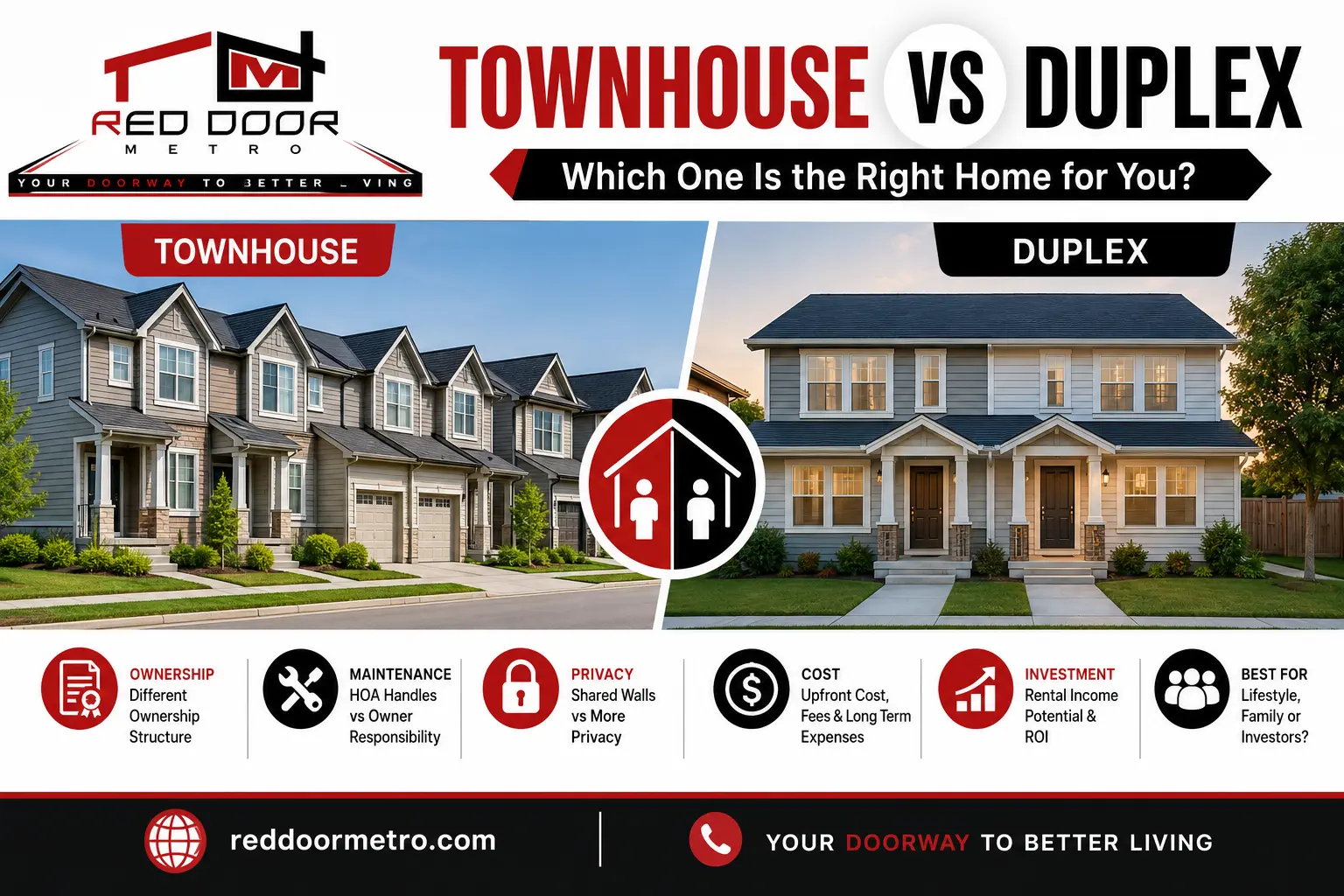
If you’re planning to buy a home, you’ve probably come across different property types, including townhouses and duplexes. At first glance, they can look similar because both share at least one wall with another home. However, they differ in ownership, layout, maintenance responsibilities, privacy, and long-term investment potential.
Choosing between a townhouse and a duplex isn’t just about appearance. The right option depends on your lifestyle, budget, future plans, and whether you’re buying a home to live in or as an investment.
For some buyers, a townhouse offers a low-maintenance lifestyle with community amenities. For others, a duplex provides greater flexibility, more privacy, and even the opportunity to earn rental income.
Understanding the differences before making an offer can help you avoid costly surprises and choose a property that meets your long-term goals.
In this guide, we’ll explain what townhouses and duplexes are, how they differ, their advantages and disadvantages, and which type of home may be the better choice for you.
What Is a Townhouse?
A townhouse is a multi-level home that shares one or two side walls with neighboring homes but has its own private entrance.
Unlike a condominium, townhouse owners typically own both the interior and exterior of their unit, along with the land directly beneath it. However, ownership rules can vary depending on the community and local laws.
Most townhouses are located in planned neighborhoods managed by a homeowners association (HOA).
These communities often include shared amenities such as:
- Swimming pools
- Fitness centers
- Clubhouses
- Parks
- Walking trails
- Playground areas
- Community landscaping
Because many exterior maintenance tasks are handled through the HOA, townhouses appeal to buyers who want a more convenient lifestyle.
Common Features of a Townhouse
Although every property is different, many townhouses include:
- Two or three stories
- Attached garage
- Small private patio or backyard
- Shared side walls
- Private front entrance
- Multiple bedrooms
- Modern kitchens
- Community-managed landscaping
Townhouses are common in suburban neighborhoods as well as urban areas where land is limited.
Advantages of Buying a Townhouse
Townhouses have become increasingly popular because they offer many of the benefits of homeownership without requiring as much maintenance as a detached single-family home.
Lower Maintenance
One of the biggest advantages is convenience.
In many townhouse communities, the HOA handles services such as:
- Lawn care
- Exterior painting
- Roof maintenance
- Snow removal
- Common area landscaping
- Community amenities
This allows homeowners to spend less time maintaining their property.
More Affordable Than Many Single-Family Homes
In many housing markets, townhouses cost less than comparable detached homes.
This lower purchase price makes them attractive to:
- First-time home buyers
- Young professionals
- Small families
- Retirees
Buyers may also qualify for a larger or newer home than they could afford if purchasing a detached house.
Access to Community Amenities
Many townhouse developments include amenities that would be expensive for individual homeowners to build or maintain.
Depending on the neighborhood, residents may enjoy:
- Community pools
- Tennis courts
- Fitness centers
- Clubhouses
- Dog parks
- Walking trails
These features can add value and improve quality of life.
Strong Sense of Community
Because homes are located close together, townhouse neighborhoods often encourage interaction among neighbors.
Many communities organize:
- Holiday events
- Neighborhood gatherings
- Social clubs
- Community improvement projects
For buyers who enjoy an active neighborhood atmosphere, this can be a major benefit.
Disadvantages of Buying a Townhouse
While townhouses offer many advantages, they aren’t the perfect choice for everyone.
Homeowners Association (HOA) Fees
Most townhouse communities require monthly or quarterly HOA dues.
These fees help pay for:
- Exterior maintenance
- Landscaping
- Amenities
- Insurance for common areas
- Community improvements
Before buying, it’s important to understand exactly what the HOA covers and how much the fees may increase over time.
HOA Rules and Restrictions
Living in an HOA community often means following certain rules.
Examples may include restrictions on:
- Exterior paint colors
- Fencing
- Landscaping
- Parking
- Holiday decorations
- Rental policies
- Pets
Some buyers appreciate these standards because they help maintain neighborhood appearance, while others prefer fewer restrictions.
Less Privacy
Because townhouses share walls with neighboring homes, residents may occasionally hear noise from adjacent units.
Outdoor space is also typically smaller than what you’ll find with many detached homes.
If privacy is one of your highest priorities, a townhouse may not be your ideal choice.
What Is a Duplex?
A duplex is a residential building that contains two separate living units within the same structure.
Each unit usually has:
- Its own entrance
- Kitchen
- Bathrooms
- Bedrooms
- Living area
- Utility connections
The units may be positioned:
- Side by side
- One above the other
From the outside, a duplex often looks like a single home.
Inside, however, it functions as two independent residences.
Who Owns a Duplex?
Ownership depends on how the property is legally structured.
In many cases, one owner purchases the entire duplex and owns both units.
That owner may choose to:
- Live in one unit and rent the other.
- Rent both units.
- Use one unit for extended family members.
- Occupy both units.
In some areas, duplex units can also be legally divided and sold separately, though this is less common than whole-property ownership.
Advantages of Buying a Duplex
Duplexes offer several unique benefits that make them attractive to homeowners and real estate investors.
Opportunity to Earn Rental Income
One of the biggest advantages is the ability to generate income.
Many buyers choose to live in one unit while renting out the second.
Rental income may help offset:
- Mortgage payments
- Property taxes
- Insurance
- Maintenance costs
For buyers interested in building long-term wealth through real estate, this can be a significant advantage.
Greater Flexibility
A duplex provides options that many other property types don’t.
For example, you might:
- House aging parents nearby.
- Give adult children their own living space.
- Create a guest suite.
- Use one unit as a home office.
- Rent one or both units.
This flexibility makes duplexes appealing for changing family needs.
Potential Investment Growth
In addition to possible appreciation in property value, duplex owners may benefit from ongoing rental income.
Over time, rental payments can help build equity while reducing out-of-pocket housing costs.
Many first-time real estate investors begin with duplexes because they offer the opportunity to become a landlord while still living on the property.
Disadvantages of Buying a Duplex
Like every property type, duplexes also have potential drawbacks.
More Maintenance Responsibility
Unlike many townhouse communities, duplex owners are generally responsible for maintaining the property.
Responsibilities often include:
- Roof repairs
- Lawn care
- Landscaping
- Exterior maintenance
- Plumbing repairs
- HVAC servicing
- Driveway maintenance
Owning a duplex often requires more time, effort, and budgeting for repairs.
Being a Landlord
If you rent one of the units, you’ll also become a landlord.
That may involve:
- Finding tenants
- Collecting rent
- Handling maintenance requests
- Managing lease agreements
- Addressing tenant concerns
Some owners enjoy this role, while others prefer a property that doesn’t involve rental management.
Higher Upfront Costs
Because duplexes can produce rental income, they sometimes have higher purchase prices than comparable townhouses.
Lenders may also have different financing requirements depending on whether the property will be owner-occupied or used as an investment.
Buyers should carefully evaluate both the purchase price and long-term financial benefits before making a decision.
Townhouse vs Duplex: Understanding the Main Differences
Although townhouses and duplexes may appear similar from the outside, they serve different purposes and appeal to different types of buyers.
Townhouse
A townhouse is typically designed for buyers who want a primary residence with less exterior maintenance. Most are located in HOA-managed communities and offer access to shared amenities, making them a popular choice for those seeking convenience and a neighborhood lifestyle.
Duplex
A duplex is often better suited for buyers who want greater flexibility or the opportunity to generate rental income. Owners usually take on more maintenance responsibilities, but they also have more control over the property and its use.
The right choice depends on your budget, lifestyle, willingness to manage maintenance, and whether you’re looking for a home, an investment, or both.
Maintenance Responsibilities
One of the biggest differences between a townhouse and a duplex is who is responsible for maintaining the property.
If you prefer spending weekends relaxing instead of mowing the lawn or scheduling roof repairs, this difference deserves careful consideration.
Townhouse Maintenance
In most townhouse communities, the homeowners association (HOA) handles many exterior maintenance tasks.
Depending on the community, HOA services may include:
- Lawn care
- Landscaping
- Roof maintenance
- Exterior painting
- Snow removal
- Maintenance of shared amenities
- Common area insurance
This arrangement gives homeowners a more hands-off experience, although it comes with monthly HOA fees.
Always review the HOA documents before purchasing so you understand exactly what’s covered.
Duplex Maintenance
Duplex owners are generally responsible for maintaining the entire property unless another agreement is in place.
That typically includes:
- Roof repairs
- Exterior painting
- Lawn maintenance
- Driveway repairs
- Plumbing
- Electrical systems
- Heating and cooling equipment
If you own both units, every repair becomes your responsibility.
While this means more work, it also gives you complete control over maintenance decisions and improvements.
Privacy and Noise
Privacy is another important factor when comparing these two property types.
Although both share at least one wall, the overall living experience can be quite different.
Living in a Townhouse
Townhouses are usually built in rows with homes attached on both sides.
Because several homes are connected, you may occasionally hear:
- Music
- Footsteps
- Children playing
- Pets
- Everyday household activity
Newer construction often includes better sound insulation, but some level of shared noise is common.
Outdoor areas are also generally smaller than detached homes.
Living in a Duplex
A duplex shares only one wall between the two units.
That often means:
- Fewer shared walls
- More outdoor space
- Less neighborhood traffic
- Greater separation between households
If you own both units, you also have more control over who lives next door.
Many owner-occupants choose tenants carefully, helping create a quieter living environment.
Cost Comparison
Purchase price is one of the first things buyers compare.
The cost of a townhouse or duplex varies by location, demand, size, and condition, but there are some general differences.
Townhouse Costs
Townhouses often have:
- Lower purchase prices than detached homes
- HOA fees
- Lower maintenance expenses
- Smaller repair budgets
- Shared community costs
For buyers focused on predictable monthly expenses, this can be appealing.
Duplex Costs
Duplexes may have:
- Higher purchase prices
- Higher maintenance costs
- Larger repair budgets
- Greater insurance costs
- Potential rental income
Although ownership costs may be higher, rental income from one unit can offset a significant portion of your monthly housing expenses.
When comparing costs, it’s important to look beyond the purchase price and consider the property’s long-term financial impact.
Investment Potential
If you’re thinking about building wealth through real estate, investment potential should be part of your decision.
Townhouse as an Investment
Townhouses can make excellent investment properties, especially in areas with strong demand from renters.
Benefits include:
- Lower maintenance compared to detached homes
- Attractive amenities
- Strong rental demand in many markets
- Easier resale for first-time buyers
However, HOA rules may limit:
- Short-term rentals
- Leasing frequency
- Property modifications
Always review HOA regulations before purchasing an investment townhouse.
Duplex as an Investment
A duplex is often considered one of the best entry points into real estate investing.
Many buyers use a strategy known as house hacking.
This means:
- Living in one unit
- Renting out the second unit
The rental income can help pay for:
- Monthly mortgage payments
- Property taxes
- Insurance
- Maintenance expenses
Some owners eventually move out and rent both units, turning the property into a full investment.
For buyers interested in long-term wealth building, duplexes offer opportunities that townhouses generally cannot.
Appreciation and Resale Value
Both townhouses and duplexes have the potential to increase in value over time.
However, appreciation depends on several factors, including:
- Local housing market
- Neighborhood demand
- Property condition
- School districts
- Nearby amenities
- Employment growth
Neither property type consistently outperforms the other in every market.
Well-maintained homes in desirable neighborhoods often appreciate regardless of whether they’re townhouses or duplexes.
Which Is Better for First-Time Home Buyers?
The answer depends on your goals.
A townhouse may be the better choice if you:
- Want lower maintenance
- Prefer community amenities
- Don’t want to manage tenants
- Like predictable monthly responsibilities
- Plan to use the property primarily as your home
A duplex may be a better option if you:
- Want to offset your mortgage with rental income
- Don’t mind additional maintenance
- Are interested in becoming a landlord
- Want greater flexibility
- View real estate as a long-term investment
Neither choice is universally better.
The right property depends on your lifestyle, financial situation, and future plans.
Which Property Is Better for Families?
Families often prioritize space, safety, and convenience.
A townhouse may be ideal for families who appreciate:
- Community playgrounds
- Swimming pools
- Walking trails
- Lower maintenance
- Neighborhood activities
A duplex may appeal to families who want:
- More privacy
- Extra living space
- Room for extended family
- A separate unit for aging parents
- Rental income to reduce housing costs
Think about both your current needs and where your family may be in five or ten years.
Common Misconceptions
There are several myths about townhouses and duplexes that can confuse buyers.
Myth: Townhouses Are the Same as Condos
Not exactly.
Townhouses usually include ownership of both the home and the land beneath it, while condominium ownership often covers only the interior living space, with the exterior maintained by the condominium association.
Myth: Duplexes Are Only for Investors
Not true.
Many duplex owners live in one unit while using the other for family members or rental income.
Owner-occupied duplexes are very common.
Myth: Townhouses Have No Maintenance
While many exterior tasks are handled by the HOA, homeowners remain responsible for maintaining the interior of their unit.
This includes items such as:
- Appliances
- Plumbing fixtures
- Flooring
- Interior walls
- Heating and cooling systems
Myth: Duplexes Always Generate Easy Income
Owning rental property requires time and responsibility.
Vacancies, maintenance, repairs, and tenant management should all be considered before purchasing a duplex as an investment.
Frequently Asked Questions
Is a townhouse cheaper than a duplex?
In many markets, townhouses have a lower purchase price than duplexes. However, monthly HOA fees may increase the overall cost of ownership. A duplex may cost more upfront but can provide rental income that helps offset ongoing expenses.
Can you rent out a townhouse?
Yes. Many townhouse owners rent their properties, although some homeowners associations have restrictions on leasing. Always review the HOA rules before purchasing if you plan to rent the home.
Can you live in one side of a duplex and rent the other?
Yes. This is one of the most common reasons buyers purchase duplexes. Renting one unit while living in the other can help reduce monthly housing costs.
Which property type offers more privacy?
A duplex generally offers more privacy because it shares only one wall with another unit. Townhouses are often attached to homes on both sides and are located in more densely built communities.
Which is easier to maintain?
Townhouses are usually easier to maintain because homeowners associations often handle exterior maintenance and landscaping. Duplex owners are typically responsible for maintaining the entire property.
Final Thoughts
Both townhouses and duplexes offer unique advantages, and the right choice depends on what you want from homeownership.
A townhouse is often a great fit for buyers who value convenience, lower maintenance, and access to community amenities. It’s especially appealing for first-time buyers, busy professionals, and retirees who want a simpler lifestyle without many exterior maintenance responsibilities.
A duplex, on the other hand, provides greater flexibility and stronger income potential. Whether you plan to live in one unit and rent the other or purchase it as a long-term investment, a duplex can help you build equity while generating rental income. The trade-off is that you’ll usually have more maintenance responsibilities and, if you rent a unit, the duties of being a landlord.
Before making your decision, consider your budget, lifestyle, long-term goals, and willingness to handle property maintenance. Taking the time to evaluate these factors will help you choose a home that not only meets your current needs but also supports your financial future.