

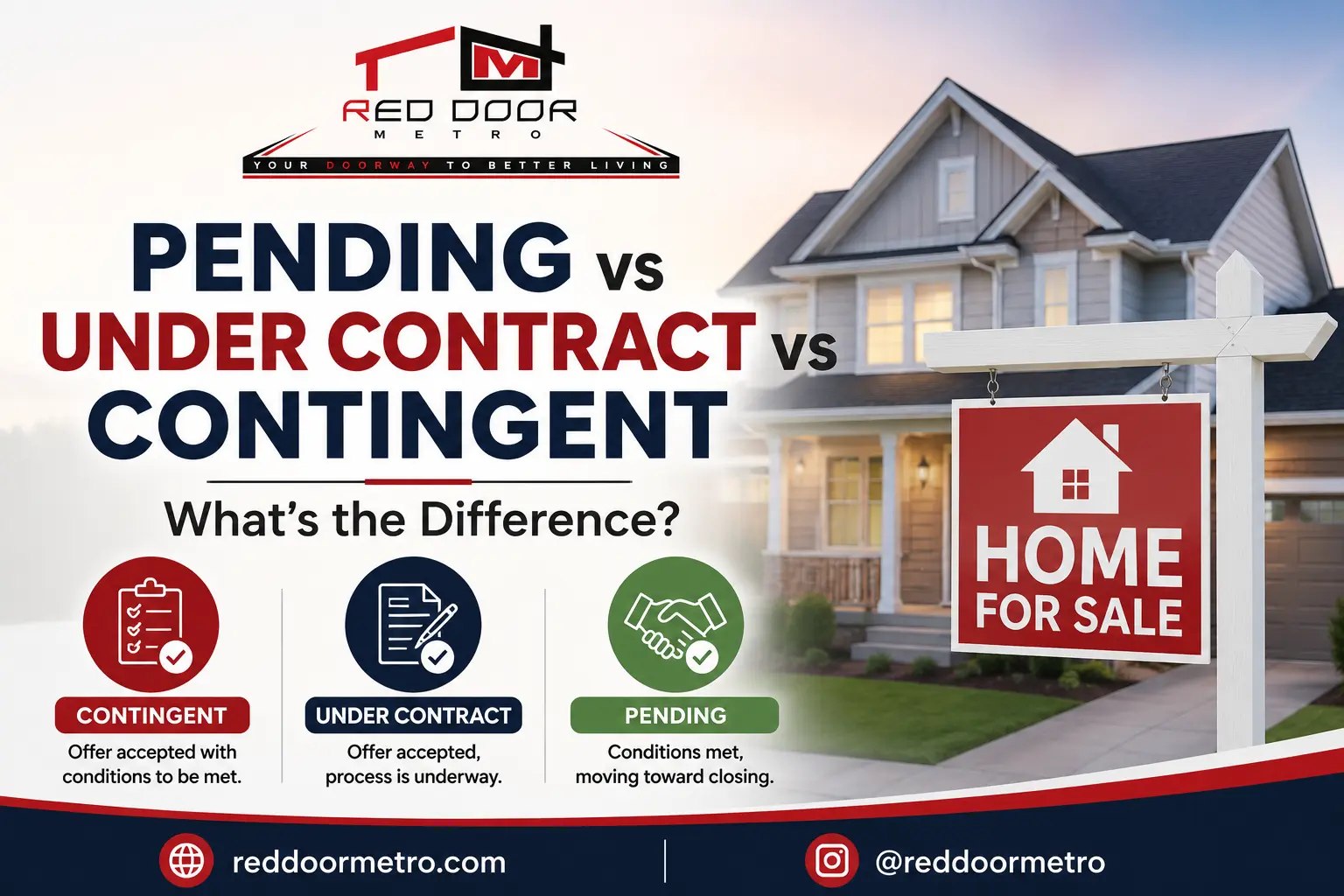
If you’ve been searching for a home online, you’ve probably come across listings labeled Pending, Under Contract, or Contingent. At first glance, these terms may seem interchangeable because they all suggest that a seller has accepted an offer. However, they actually represent different stages of the home-buying process, and understanding those differences can help you make smarter real estate decisions.
For buyers, knowing what each status means can determine whether it’s worth pursuing a property or moving on to another opportunity. For sellers, these terms provide insight into where a transaction stands and what could still happen before closing.
The truth is, not every accepted offer leads to a successful sale. Financing issues, inspection problems, appraisal gaps, and other unexpected obstacles can cause contracts to fall apart. That’s why understanding the difference between pending, under contract, and contingent is so important.
In this guide, you’ll learn exactly what each status means, how they affect buyers and sellers, when you can still make an offer, and what to expect as a home moves from being listed for sale to officially sold.
Why Home Listing Status Matters
Every home listed for sale follows a series of stages before ownership changes hands. As buyers submit offers and sellers negotiate contracts, the property’s status changes to reflect where it is in the transaction.
These status updates help everyone involved understand whether the home is still available, whether negotiations are complete, or whether the sale is approaching the finish line.
A typical home sale usually follows this path:
- Home is listed for sale
- Buyers schedule showings
- Offers are submitted
- Seller accepts an offer
- Buyer completes inspections and financing
- Closing documents are finalized
- Property is officially sold
The terms Contingent, Under Contract, and Pending all occur after a seller accepts an offer but before the transaction is complete.
Although they sound similar, they represent different levels of certainty that the sale will actually close.
What Does “Contingent” Mean?
A home is considered contingent when the seller has accepted a buyer’s offer, but the sale depends on one or more conditions being satisfied before the transaction can move forward.
These conditions are called contingencies, and they’re written directly into the purchase agreement to protect both the buyer and the seller.
Until those contingencies are completed or waived, either party may still have the right to cancel the contract under certain circumstances.
Simply put:
An accepted offer plus outstanding conditions equals a contingent sale.
Because contingencies are common in residential real estate, many homes remain in contingent status for several days or even several weeks.
Common Types of Contingencies
Every real estate contract is different, but some contingencies appear more frequently than others.
Home Inspection Contingency
One of the most common contingencies allows the buyer to hire a licensed home inspector to evaluate the property’s condition.
During the inspection, the inspector examines major components such as:
- Roof
- Foundation
- Plumbing
- Electrical system
- Heating and cooling equipment
- Windows and doors
- Structural integrity
- Water damage
- Safety concerns
If significant issues are discovered, the buyer may request repairs, negotiate a price reduction, ask for a closing credit, or, in some situations, cancel the agreement altogether.
Financing Contingency
Most buyers rely on a mortgage to purchase a home.
Even after receiving mortgage pre-approval, the lender must complete the underwriting process before issuing final approval.
If the buyer cannot secure financing, the financing contingency allows them to withdraw from the contract without losing certain contractual protections.
Appraisal Contingency
Mortgage lenders generally require an independent appraisal before approving a home loan.
The appraiser determines whether the home’s market value supports the agreed purchase price.
For example, imagine a buyer agrees to purchase a home for $725,000, but the appraisal values it at $695,000.
At that point, several things could happen:
- The seller lowers the purchase price.
- The buyer pays the difference in cash.
- Both parties negotiate a compromise.
- The contract is canceled.
This contingency helps protect buyers from paying significantly more than a property’s appraised value.
Home Sale Contingency
Some buyers need to sell their current home before purchasing another one.
A home sale contingency gives the buyer additional time to complete that sale before finalizing the purchase of the new property.
While this contingency protects the buyer, it also creates additional uncertainty because two separate real estate transactions must successfully close.
Title Contingency
Before closing, a title company researches the property’s ownership history.
The goal is to confirm that:
- The seller legally owns the property.
- There are no outstanding ownership disputes.
- Unpaid liens have been resolved.
- The title can be transferred to the buyer without legal complications.
If unexpected title issues are discovered, they usually must be resolved before closing can proceed.
Can You Still Buy a Contingent Home?
Yes—in many cases, you can.
Although the seller has already accepted an offer, contingent homes sometimes become available again if one of the contract’s conditions isn’t satisfied.
For example, the buyer may:
- Fail to obtain financing
- Walk away after the inspection
- Decide not to move forward
- Miss important contract deadlines
Because these situations occur more often than many people realize, some sellers continue accepting backup offers while the property is in contingent status.
A backup offer doesn’t replace the original contract. Instead, it gives another qualified buyer the opportunity to step in if the first agreement falls apart.
For buyers who truly love a property, submitting a backup offer can be a smart strategy.
What Does “Under Contract” Mean?
A home is considered under contract after the buyer and seller have signed a legally binding purchase agreement.
At this stage, both parties have agreed on the purchase price, closing timeline, and other important terms.
However, the transaction isn’t finished.
Several important steps usually remain before the sale officially closes.
These often include:
- Completing inspections
- Finalizing mortgage approval
- Ordering the appraisal
- Conducting the title search
- Reviewing required disclosures
- Preparing closing documents
In many local Multiple Listing Services (MLS), Under Contract serves as a broad status that simply means the property is no longer actively accepting offers because a contract has been signed.
Depending on your local market, some MLS systems may use Under Contract before changing the listing to Pending, while others may rely primarily on Contingent and Pending instead.
Why an Under Contract Home Can Still Return to the Market
Signing a purchase agreement doesn’t guarantee the sale will close.
Real estate transactions involve many moving parts, and unexpected issues can arise even after both parties have signed the contract.
Some of the most common reasons include:
- Mortgage financing is denied
- Home inspection reveals costly repairs
- Low appraisal creates a pricing dispute
- Buyer loses their job before closing
- Title problems delay the transaction
- Buyer fails to meet contractual deadlines
- Insurance issues prevent loan approval
When this happens, the seller may terminate the contract and place the property back on the market.
That’s why experienced buyers sometimes continue watching homes listed as under contract.
What Does “Pending” Mean?
A home enters pending status when the transaction has successfully moved beyond most major hurdles.
By this point, the buyer and seller have resolved nearly all outstanding issues, and the closing date is typically approaching.
Although every transaction is unique, a pending sale often means:
- Inspection negotiations have been completed.
- Financing has been approved.
- The appraisal has been accepted.
- Title work is nearly finished.
- Closing documents are being prepared.
In other words, the sale is entering its final stage.
While there’s still a small possibility the transaction could fall through, pending homes generally have a much higher chance of closing successfully than contingent properties.
Pending vs Under Contract vs Contingent: Understanding the Key Differences
Although all three terms indicate that a seller has accepted an offer, they represent different stages of the transaction.
Contingent
A contingent home has an accepted offer, but important conditions still need to be met before the sale can move forward.
This stage carries the most uncertainty because inspections, financing, appraisals, or other contingencies may still affect the outcome. Sellers often continue accepting backup offers during this period.
Under Contract
An under contract home means the buyer and seller have signed a legally binding purchase agreement.
The transaction is officially underway, but several important tasks—such as inspections, financing, or title work—may still be in progress. Depending on the local MLS, backup offers may still be accepted.
Pending
A pending home has successfully moved beyond most major contingencies and is approaching closing.
The transaction is generally considered close to completion, and sellers rarely accept new offers because the likelihood of the sale falling through is much lower.
Which Status Gives Buyers the Best Opportunity?
If you’re hoping to purchase a home that’s already under agreement, contingent properties usually offer the greatest opportunity.
Since one or more contract conditions still need to be satisfied, there’s a higher chance that the original agreement could fall apart. If that happens, sellers often look to qualified backup buyers instead of starting the marketing process over again.
Homes listed as under contract may also become available again, although the chances depend on where the transaction stands and the terminology used by the local MLS.
By contrast, pending homes are typically very close to closing, making them the least likely to return to the market.
What Happens After a Home Becomes Pending?
Once a property reaches pending status, both the buyer and seller are preparing for the final step—closing.
Although much of the hard work has already been completed, several important tasks still need to happen before ownership officially transfers.
These may include:
- Final loan approval from the lender
- Reviewing and signing closing documents
- Completing the title transfer
- Scheduling the final walkthrough
- Confirming homeowner’s insurance
- Transferring utilities
- Funding the mortgage loan
If everything goes according to plan, the home will move from Pending to Sold, and the buyer will receive the keys on closing day.
Can a Pending Home Fall Through?
Yes, but it’s much less common than during the contingent stage.
Most major obstacles have already been resolved, but unexpected situations can still arise.
Examples include:
- The buyer loses their job before closing.
- The lender withdraws loan approval.
- A title issue is discovered at the last minute.
- The property suffers unexpected damage before closing.
- One of the parties fails to meet the terms of the contract.
Although these situations are rare, they do happen. That’s why buyers interested in a pending home sometimes ask their real estate agent to monitor the listing in case it returns to the market.
What Should Buyers Do When a Home Is Contingent, Under Contract, or Pending?
Understanding the property’s status can help you decide your next move.
If the Home Is Contingent
This is usually the best time to ask your real estate agent about submitting a backup offer.
Since contingencies still need to be satisfied, there’s a greater chance the current contract could fall apart.
If you’re serious about the property, staying in touch with the listing agent can keep you informed if the home’s status changes.
If the Home Is Under Contract
Ask whether the seller is accepting backup offers.
Some sellers prefer having another qualified buyer ready in case the first transaction doesn’t close.
Even if backup offers aren’t being accepted, your agent can continue monitoring the property.
If the Home Is Pending
A pending home is generally close to closing.
Instead of waiting, many buyers continue searching for similar properties while keeping an eye on the pending listing.
If the transaction unexpectedly falls through, you’ll be ready to act quickly.
What Should Sellers Know About These Listing Statuses?
For sellers, each status represents a different level of confidence that the sale will close.
During the Contingent Stage
The buyer is still completing important milestones, so there’s a higher chance the contract could be canceled.
Many sellers continue accepting backup offers during this period to reduce the risk of starting over.
During the Under Contract Stage
The transaction is progressing, but important tasks are still underway.
Communication between the buyer, lender, title company, inspectors, and real estate professionals becomes especially important during this phase.
During the Pending Stage
Most of the difficult work has already been completed.
At this point, sellers are usually preparing for moving day while waiting for the scheduled closing.
Why Different Real Estate Websites May Show Different Statuses
One thing that confuses many buyers is seeing different listing statuses on different websites.
For example:
- Zillow may show Pending.
- Realtor.com may display Contingent.
- A local MLS may use Under Contract.
- Redfin may display another variation.
This happens because local Multiple Listing Services (MLS) don’t all use the same terminology.
Some MLS systems have several contract stages, while others simplify the process into fewer categories.
Although the wording may vary, the overall meaning remains similar: the seller has accepted an offer, but the sale has not officially closed.
If you’re unsure about a property’s status, your real estate agent can explain exactly what it means in your local market.
Common Misconceptions About Home Listing Statuses
Many buyers misunderstand these terms, leading to missed opportunities or unnecessary disappointment.
Let’s clear up a few common myths.
Myth: Pending Means the Home Is Already Sold
Not exactly.
A pending home is close to closing, but ownership hasn’t officially transferred yet.
The transaction isn’t complete until the closing documents are signed and recorded.
Myth: You Can’t Buy a Contingent Home
That’s not always true.
Many sellers accept backup offers while contingencies are being resolved.
If the original contract falls through, your offer could become the primary contract.
Myth: Under Contract and Pending Mean Exactly the Same Thing
While the terms are similar, they aren’t always identical.
Depending on the local MLS, Under Contract often describes an earlier stage of the transaction, while Pending usually means the sale is much closer to closing.
Myth: Every Accepted Offer Closes Successfully
Unfortunately, no.
Real estate contracts sometimes fail because of financing issues, inspections, appraisals, title problems, or unexpected life events.
That’s why backup offers remain common in many markets.
Frequently Asked Questions
Is contingent better than pending?
Neither status is “better,” but they indicate different stages of the transaction. A contingent home still has conditions that must be satisfied, while a pending home is generally much closer to closing.
Can I make an offer on a contingent property?
Yes. In many cases, sellers are willing to accept backup offers while contingencies are being resolved.
Can I make an offer on a pending home?
Usually not, although every seller is different. Since pending homes are close to closing, most sellers stop accepting new offers.
How long does a home stay contingent?
It varies, but many homes remain contingent for one to three weeks while inspections, financing, and appraisals are completed.
How long does a home stay pending?
Pending status often lasts between one and four weeks, depending on the financing process, title work, and scheduled closing date.
Can a home go from pending back to active?
Yes.
Although it’s less common than during the contingent stage, pending sales occasionally fall through and return to the market.
Tips for First-Time Home Buyers
If you’re new to buying a home, don’t let listing statuses discourage you.
Here are a few practical tips:
- Work with an experienced local real estate agent.
- Get pre-approved before you start shopping.
- Move quickly when you find a home you love.
- Ask about backup offers on contingent properties.
- Continue looking at other homes while waiting.
- Don’t assume a pending sale is guaranteed to close.
Being prepared gives you more options if an opportunity becomes available.
Final Thoughts
The terms Pending, Under Contract, and Contingent all indicate that a seller has accepted an offer, but they represent different milestones in the home-selling process.
A contingent home still has important conditions that must be met before the transaction can move forward. An under contract home means the buyer and seller have signed a purchase agreement, but inspections, financing, or other steps may still be in progress. A pending home is typically in the final stage before closing, with most major hurdles already cleared.
For buyers, understanding these differences can help you recognize opportunities that others may overlook. A contingent property may still become available, while a pending home is generally much closer to being sold. For sellers, these statuses provide a clear picture of where the transaction stands and what remains before closing.
Whether you’re purchasing your first home or preparing to list your current one, understanding these listing statuses will help you navigate the real estate process with greater confidence and make more informed decisions along the way.