
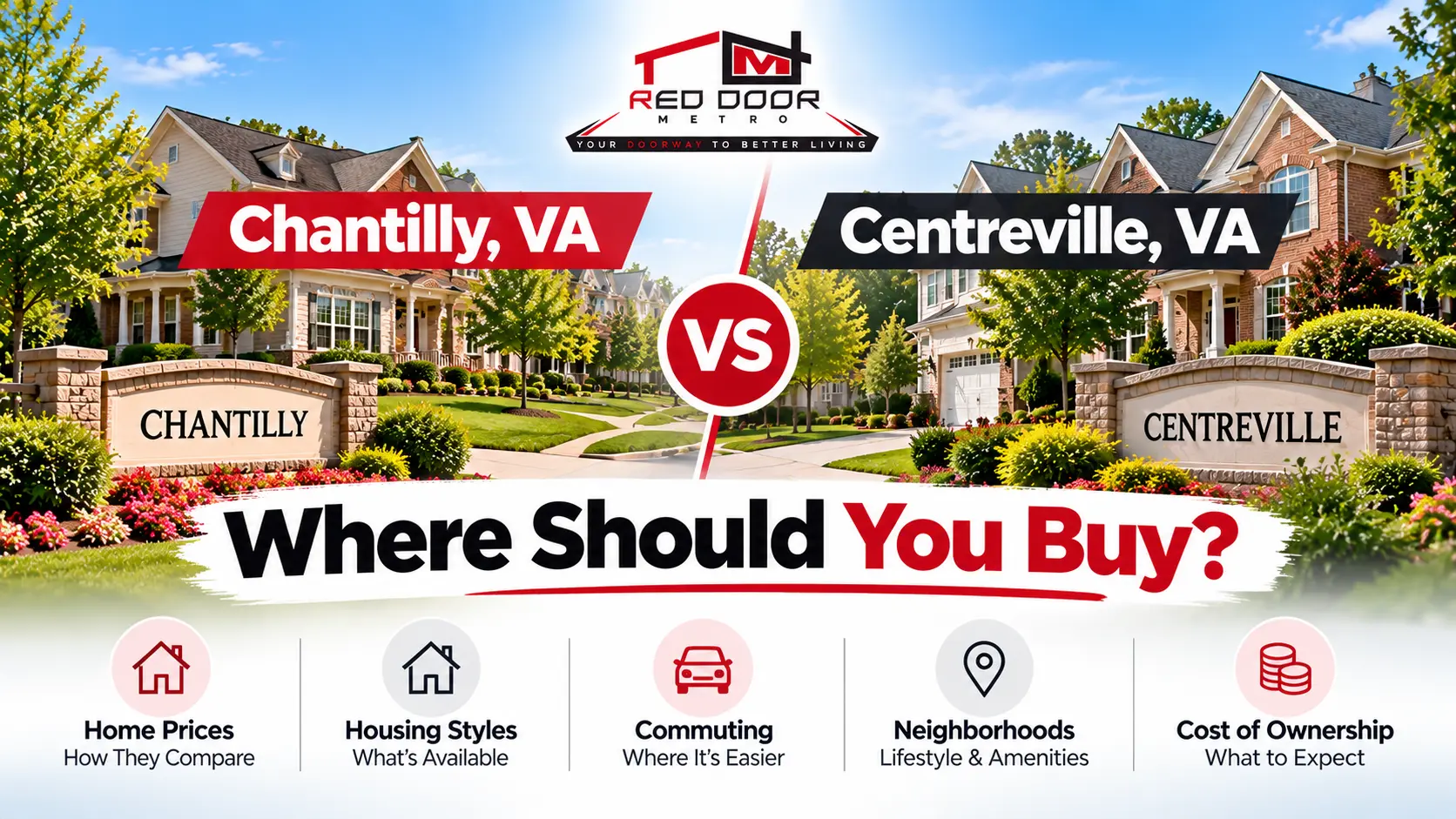
If you are deciding between Chantilly and Centreville, Virginia, the right choice depends on the home you want, the price you can comfortably afford, and where you need to travel each day. Both communities offer suburban living in the western Fairfax County area, but the homes available, neighborhood layouts, and practical commute options can differ from one property to another.
Chantilly may appeal to buyers prioritizing access to the Dulles corridor and established residential communities. Centreville may be attractive to buyers comparing a wider range of housing options and access to destinations around western Fairfax County. Neither is automatically the better value. The best comparison is between specific homes that meet your requirements.
The short answer
Consider Chantilly if…
You want to explore established residential communities and need convenient access to destinations along the Route 28, Route 50, or Dulles-area corridors.
Consider Centreville if…
You want to compare a range of home types and communities while evaluating access to destinations around western Fairfax County and beyond.
These are general starting points. Verify commute times, available homes, and property details for each address.
1. First, Compare the Housing Markets
Home prices are often the first thing buyers compare, but the numbers require context. The median price for an entire community includes different home sizes, property types, conditions, and locations. It does not tell you what a particular detached home or townhome should cost.
As one historical reference point, Realtor.com reported the following figures for September 2026:
Chantilly
Median sold price
$720,000
Median listing price: approximately $699,500
Centreville
Median sold price
$630,000
Median listing price: approximately $619,950
Source: Realtor.com market summaries for September 2026. These are historical, area-wide figures—not current quotes, guaranteed values, or predictions for 2027. Median sold prices and median listing prices measure different things, and the mix of properties in each area can differ.
In this snapshot, Centreville had lower median listing and sold prices than Chantilly. That does not prove that an equivalent home will cost less in Centreville. Buyers should compare similar properties in comparable condition and use recent closed sales from the relevant neighborhood.
How to make a fair price comparison
Imagine you are choosing between a townhome in Chantilly and a detached house in Centreville. Comparing only their asking prices would not tell you which offers better value. You would also need to compare the living space, condition, outdoor area, association fees, taxes, and likely maintenance expenses.
For a more meaningful comparison, ask your real estate professional to identify recent closed sales with similar property characteristics. Then calculate the full monthly cost for each home. This is more useful than deciding based on a citywide median alone.
2. What Kind of Home Are You Looking For?
Your preferred home style may narrow the decision faster than the city name. Both areas include different residential settings, but the exact choices depend on current inventory and the particular communities you search.
| Your priority | How to evaluate Chantilly | How to evaluate Centreville |
|---|---|---|
| Detached house | Compare established communities such as Greenbriar, Brookfield, and Poplar Tree Estates. | Compare detached homes in communities such as Little Rocky Run and other nearby residential areas. |
| Townhome | Check current listings, HOA fees, parking, and exterior-maintenance obligations. | Compare the same details across available developments and property ages. |
| Condominium | Review monthly fees, association finances, building condition, and any assessments. | Review monthly fees, association finances, building condition, and any assessments. |
| Move-in-ready property | Inspect renovation quality and compare the asking price with recent similar sales. | Apply the same inspection and comparable-sales process. |
| Home needing updates | Estimate repair costs and account for the time required to complete improvements. | Estimate repair costs and account for the time required to complete improvements. |
One important rule: do not assume that a particular home style is exclusive to either community. Search current listings in both locations and compare the properties that actually fit your requirements.
3. The Commute Test: Where Do You Need to Go?
The better location often depends on your daily destination. Chantilly is associated with the Route 28 and Route 50 corridors and access to the Dulles area. Centreville offers access to other parts of western Fairfax County, including routes used by people traveling toward employment, retail, and residential destinations across Northern Virginia.
Neither location guarantees a shorter commute. Traffic, departure time, toll-road use, school schedules, construction, and the precise address can change the journey significantly.
Run this five-point commute test before you choose
- Enter the exact property address and your workplace in a navigation app.
- Check estimated travel times at your usual departure and return hours.
- Calculate tolls, parking, fuel, and any transit costs.
- Check public transportation connections if you plan to use them.
- Repeat the test for every serious property—not just for the general area.
If your work takes you frequently to the Dulles technology corridor or the airport, Chantilly may be worth a closer look. If your regular destinations are elsewhere in western Fairfax County, Centreville could be just as practical—or more convenient for a specific address. Test both rather than relying on assumptions.
Buyers who rely on Metrorail should also plan carefully. Neither community has a Metro station at the center of its residential area. Verify the drive or transit connection to the station you would actually use.
4. Everyday Life: Neighborhood Feel, Shopping, and Recreation
Both Chantilly and Centreville provide access to suburban services, retail areas, restaurants, and recreation. The difference you experience will often come down to your street and the specific property rather than the broader community label.
Life in Chantilly
- Explore established residential communities.
- Assess access to the Route 28 and Route 50 corridors.
- Consider routes to Dulles-area destinations.
- Check the distance to the services you use most.
Life in Centreville
- Compare a range of residential communities.
- Assess routes to western Fairfax County destinations.
- Review nearby shopping and recreation options.
- Evaluate traffic and convenience around the specific home.
Before making an offer, visit the neighborhood at different times of day. Look at traffic, street parking, road noise, pedestrian access, lighting, and the condition of surrounding properties. If you expect to walk to shops or parks, check the actual route rather than relying on a map’s straight-line distance.
5. Schools and County Details: Verify the Exact Address
School assignments can be an important part of a home search, but buyers should not assume every address marketed as Chantilly or Centreville follows the same school pathway. Confirm the current assignment with the relevant school division using the specific property address. Boundaries and programs can change.
Also verify the property’s county jurisdiction. Chantilly and Centreville are commonly associated with Fairfax County, but the broader surrounding housing market includes nearby communities in other jurisdictions. Some listings may use familiar community names even when a property falls under a different county’s tax or school systems.
Before you commit, confirm:
- The property’s legal address and county jurisdiction.
- The current real estate tax information.
- The school assignment for the relevant school year, if applicable to your decision.
- Any HOA or condominium association rules and fees.
- Property disclosures, permits, and available inspection information.
6. Which Area Could Fit Your Budget Better?
A lower asking price does not always mean a lower monthly cost. A property with an older roof, outdated HVAC equipment, or high association fees may cost more to own than a comparable home with fewer near-term expenses.
Build a side-by-side budget for the homes you are considering. Include:
| Expense | What to compare |
|---|---|
| Mortgage | Loan amount, interest rate, term, and any mortgage insurance. |
| Closing costs | Lender fees, appraisal, title-related charges, prepaid items, and settlement expenses. |
| Property taxes | Current applicable tax rate and assessed value for the exact property. |
| Insurance | Property-specific coverage, premiums, and deductibles. |
| HOA or condo fees | Current fees, included services, reserves, restrictions, and disclosed assessments. |
| Repairs and maintenance | Immediate repairs, future replacements, and routine upkeep. |
| Transportation | Tolls, fuel, parking, transit, and expected commuting costs. |
The property with the lowest asking price may not be the least expensive option over several years. For more detailed planning, read Chantilly, VA Real Estate: A 2027 Buyer’s Guide and compare the expected costs of each home before deciding.
7. A Decision Framework: Choose Based on Your Priorities
Instead of asking which town is universally better, rank the factors that matter most to your household. Use the guide below to identify where to focus your search.
These are search priorities, not guarantees. If your budget is the deciding factor, compare current listings in both areas. If commute time is most important, test both locations using actual addresses. If you are looking for a specific home style, compare available properties rather than assuming one area will have more suitable options.
8. Meet George M. Mrad and the Red Door Metro Team

George M. Mrad
Founder and CEO, Red Door Metro
George M. Mrad founded Red Door Metro, a real estate team serving buyers and sellers across Northern Virginia, Maryland, and Washington, DC. The team works with clients navigating property searches, purchase decisions, and real estate transactions across the region.
When comparing Chantilly and Centreville, a clear decision process can help buyers evaluate the details that matter: comparable sales, property condition, financing, commute, and ongoing ownership costs.
About Red Door Metro
Red Door Metro
Your Doorway to Better Living.
Red Door Metro is a real estate team affiliated with Keller Williams Metro Center, serving clients throughout Northern Virginia, Maryland, and Washington, DC. The team helps buyers and sellers navigate real estate decisions with personalized guidance and support throughout the transaction process.
If you are deciding between Chantilly and Centreville, Red Door Metro can discuss your preferred home style, budget, target locations, and commute needs to help you organize your search.
Frequently Asked Questions
Is Chantilly more expensive than Centreville?
Realtor.com reported a higher median sold price in Chantilly than in Centreville in September 2026. However, area-wide medians reflect different mixes of homes. Compare similar properties and recent closed sales to determine whether a particular home is fairly priced.
Which area is better for first-time homebuyers?
Neither area is automatically better for first-time buyers. The right choice depends on available homes, financing, down payment, monthly costs, commute, and the property type you want. Compare townhomes, condominiums, and detached homes in both locations.
Which area is better for commuting to Dulles International Airport?
Chantilly may be worth investigating because of its access to the Dulles-area road network. Actual travel time depends on the address, traffic, route, and time of day. Test the journey from each property you are considering.
Does Centreville have more affordable homes?
The September 2026 Realtor.com market snapshot showed a lower median sold price and median listing price in Centreville than in Chantilly. That does not establish that every Centreville home is more affordable. Current inventory and comparable properties should guide your search.
Are Chantilly and Centreville in Fairfax County?
Both are commonly associated with Fairfax County, but buyers should verify the county jurisdiction for the exact property, especially when considering nearby communities. Jurisdiction can affect taxes, school assignments, and public services.
Which area has better schools?
School fit is a personal decision and should not be judged by community name alone. Confirm the assigned schools for the property’s exact address through the relevant school division and review the information that matters to your household.
Should I choose Chantilly or Centreville for long-term value?
No location guarantees future appreciation. Consider the purchase price, condition, maintenance, neighborhood characteristics, financing, and how long you expect to own the home. A property that fits your needs and budget may be a more appropriate choice than relying on speculative appreciation forecasts.
Can Red Door Metro help me compare both areas?
Red Door Metro serves buyers and sellers across Northern Virginia, Maryland, and Washington, DC. Visit the Meet the Team page or contact the team to discuss your home search.
Final Verdict: Chantilly or Centreville?
Chantilly and Centreville are both worth considering if you want to buy a home in western Fairfax County. Chantilly deserves a close look if you are interested in established residential communities and access to the Dulles corridor. Centreville should also be on your list if its available homes, location, and total ownership costs better fit your priorities.
The most reliable way to choose is to compare a shortlist of actual properties. Review comparable sales, calculate full monthly costs, inspect the home, verify school and county details, and test the commute. Once those factors are clear, the better choice for your household will be easier to identify.
Ready to compare available homes? Start with Red Door Metro’s home search or meet the team to discuss your next move.
Market data in this article is a September 2026 historical snapshot and should not be interpreted as current pricing or a prediction of future performance. Prices, inventory, taxes, commute conditions, and property details change. Verify current information before making a purchase decision.